
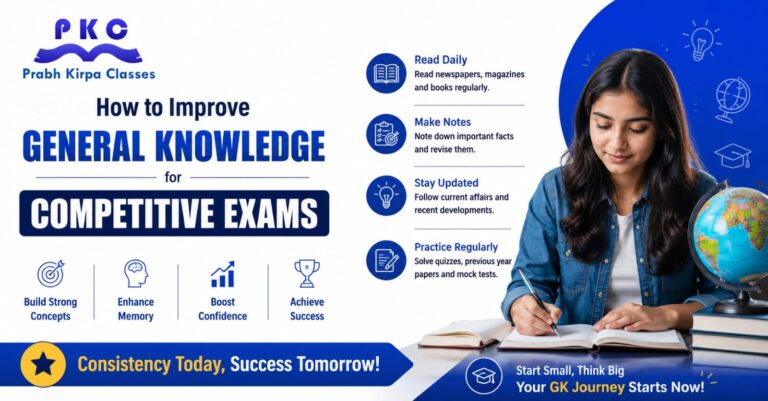
How to Improve General Knowledge for Competitive Exams
Introduction
General Knowledge (GK) plays a crucial role in almost every competitive examination. Whether you are preparing for SSC, Banking, UPSC, State PCS, Railways, Defence, Teaching Exams, CUET, or other government recruitment tests, a strong command of General Knowledge can significantly improve your overall score.
Unlike subjects that require lengthy calculations or complex problem-solving, General Knowledge can help candidates answer questions quickly and accurately. However, many students find GK challenging because it covers a vast range of topics, including history, geography, politics, economics, science, current affairs, sports, and international events.
The good news is that General Knowledge can be improved through consistent practice, smart study strategies, and regular exposure to information. This guide will help you understand effective methods to enhance your GK for competitive exams.
Why General Knowledge is Important
General Knowledge is often considered a scoring section because:
- Questions are usually direct and fact-based.
- Less time is required to answer compared to quantitative sections.
- Good GK preparation improves overall exam ranking.
- It helps in interviews and group discussions.
- It increases awareness about national and international events.
A candidate with strong GK can gain a competitive advantage over others.
Understand the Types of General Knowledge
Before preparing, it is important to understand that GK is generally divided into two categories:
1. Static General Knowledge
Static GK includes facts that do not change frequently.
Examples:
- Capitals and currencies
- Indian history
- Geography
- Important monuments
- Scientific discoveries
- Books and authors
- National parks
- Important organizations
2. Current Affairs
Current affairs involve recent events and developments.
Examples:
- Government schemes
- Sports tournaments
- International summits
- Awards and honors
- Economic developments
- Important appointments
- Scientific achievements
A balanced preparation strategy should include both static GK and current affairs.
Read Newspapers Daily
Reading newspapers is one of the most effective ways to improve General Knowledge.
Recommended newspapers include:
- The Hindu
- The Indian Express
- Business Standard
- Economic Times
While reading newspapers, focus on:
- National news
- International affairs
- Government policies
- Economy and banking
- Science and technology
- Sports
- Editorial insights
Avoid spending too much time on political debates and sensational news.
Benefits of Newspaper Reading
- Improves awareness
- Enhances vocabulary
- Develops analytical thinking
- Helps in current affairs preparation
Even 30 minutes of daily newspaper reading can make a significant difference.
Follow Monthly Current Affairs
Many competitive exams ask questions from the last 6–12 months of current affairs.
Candidates should maintain monthly current affairs notes covering:
- Awards
- Appointments
- Government schemes
- Sports events
- Important days
- International organizations
- Summits and conferences
Monthly revision helps retain information more effectively.
Create Short Notes
Writing notes is one of the best ways to remember facts.
Your notes should include:
- Important dates
- Key events
- Important personalities
- Government schemes
- Historical facts
Use bullet points instead of lengthy paragraphs.
For example:
Nobel Prize Winners
- Physics – Name
- Chemistry – Name
- Medicine – Name
Short notes make revision faster and more effective.
Use Reliable GK Books
Books provide structured knowledge and are highly useful for competitive exam preparation.
Popular GK books include:
- Lucent’s General Knowledge
- Manorama Yearbook
- Arihant General Knowledge
- General Science books
- NCERT textbooks
NCERT books from Classes 6–12 are particularly useful for building strong fundamentals.
Study NCERT Books
Many questions in competitive exams are directly or indirectly based on NCERT concepts.
Important NCERT subjects:
History
- Ancient India
- Medieval India
- Modern India
Geography
- Physical Geography
- Indian Geography
- World Geography
Political Science
- Constitution
- Democracy
- Governance
Economics
- Basic economic concepts
- Indian economy
NCERT books provide clear and authentic information.
Practice GK Questions Daily
Knowledge improves through practice.
Make it a habit to solve:
- Daily quizzes
- Weekly mock tests
- Topic-wise GK questions
- Previous year papers
Benefits include:
- Better retention
- Identification of weak areas
- Faster recall during exams
Even solving 20–30 GK questions daily can improve performance significantly.
Learn Through Educational Videos
YouTube and online learning platforms provide excellent educational content.
Topics covered include:
- Current affairs
- History
- Geography
- Science
- Polity
Video-based learning improves understanding and memory through visual explanations.
However, always verify information from trusted sources.
Focus on Important GK Topics
Certain topics appear frequently in competitive exams.
Indian History
Important areas:
- Indus Valley Civilization
- Mauryan Empire
- Gupta Empire
- Freedom Movement
- Independence
Geography
Focus on:
- Rivers
- Mountains
- Climate
- States and capitals
- National parks
Indian Polity
Study:
- Constitution
- Fundamental Rights
- Parliament
- Judiciary
- President and Prime Minister
Economy
Learn:
- GDP
- Inflation
- Banking
- Budget
- Economic terms
Science
Focus on:
- Physics basics
- Chemistry fundamentals
- Biology concepts
Mastering these areas can significantly boost your score.
Use Flashcards
Flashcards are excellent tools for memorization.
Write:
Front Side:
Question
Back Side:
Answer
Example:
Front:
Capital of Australia?
Back:
Canberra
Flashcards help in quick revision and active recall.
Revise Regularly
Many students study but forget information due to poor revision.
A simple revision schedule:
- Daily Revision
- Weekly Revision
- Monthly Revision
Regular revision strengthens memory and reduces forgetting.
Remember:
Learning without revision is incomplete preparation.
Follow Government Websites
Government websites provide authentic information regarding:
- New schemes
- Policies
- Reports
- Budget announcements
Reliable sources include:
- PIB (Press Information Bureau)
- Government ministry portals
- RBI updates
- Election Commission
These sources help candidates stay updated with accurate information.
Improve Memory Techniques
Strong memory is essential for GK preparation.
Useful techniques include:
Mnemonics
Create shortcuts to remember facts.
Visualization
Imagine events, places, and concepts.
Association Method
Link new information with existing knowledge.
Story Method
Convert facts into memorable stories.
These techniques improve long-term retention.
Participate in Quizzes
Quiz participation makes learning engaging and effective.
Benefits:
- Faster recall
- Competitive mindset
- Better confidence
- Identification of knowledge gaps
Online quiz platforms and educational channels offer daily quiz opportunities.
Use Mobile Apps Wisely
Educational apps can help improve GK through:
- Daily quizzes
- Current affairs updates
- Mock tests
- Flashcards
However, avoid excessive screen time and distractions from social media.
Use technology as a learning tool rather than entertainment.
Read Magazines and Yearbooks
Monthly magazines and annual yearbooks provide comprehensive information.
Useful resources:
- Competition magazines
- Current affairs magazines
- Yearbooks
- Exam-oriented publications
They are especially useful for revision before exams.
Analyze Previous Year Papers
Previous year papers reveal:
- Frequently asked topics
- Exam trends
- Important chapters
- Difficulty level
Benefits include:
- Better exam strategy
- Focused preparation
- Improved confidence
Candidates should solve at least the last 5–10 years of papers whenever possible.
Develop Curiosity
The most successful learners are naturally curious.
Whenever you hear:
- A new term
- A country name
- A scientific discovery
- An international event
Take a few minutes to learn more about it.
Curiosity transforms learning from a task into a habit.
Build a Daily GK Routine
A sample daily routine:
Morning (20 Minutes)
Read headlines and current affairs.
Afternoon (30 Minutes)
Study static GK topics.
Evening (20 Minutes)
Solve quizzes and MCQs.
Night (15 Minutes)
Revise notes.
This routine requires less than 90 minutes daily and can produce excellent results over time.
Common Mistakes to Avoid
Studying Without Revision
Revision is essential for retention.
Ignoring Current Affairs
Many exams heavily focus on recent events.
Using Too Many Sources
Stick to a limited number of reliable resources.
Memorizing Without Understanding
Understanding improves long-term memory.
Inconsistent Preparation
GK requires continuous effort and regular updates.
Tips for Last-Minute Revision
Before exams:
- Revise short notes.
- Read monthly current affairs compilations.
- Solve mock tests.
- Focus on important facts.
- Avoid learning completely new topics.
Last-minute preparation should emphasize revision rather than fresh learning.
Conclusion
Improving General Knowledge for competitive exams is not about studying for long hours; it is about learning consistently and strategically. A combination of newspaper reading, current affairs preparation, static GK study, regular revision, quizzes, and practice tests can help students build a strong knowledge base.
Remember that GK is a subject that grows over time. Every article you read, every quiz you attempt, and every fact you learn contributes to your overall preparation. Stay curious, remain disciplined, and make learning a daily habit. With dedication and smart preparation, you can significantly improve your General Knowledge and increase your chances of success in competitive examinations.
Newsletter
Recent Posts
How to Improve General Knowledge for Competitive Exams
Introduction General Knowledge (GK) plays a crucial role in almost

Why Claims Get Denied Without Dual Physician Certification
Some insurance policies require certification from two physicians before certain

5 June 2026 Current Affairs for Competitive Exams
Stay updated with the most important Daily Current Affairs of
Is the Terminal Illness Benefit a Real Payout?
Many policyholders wonder whether a Built-In Terminal Illness Benefit provides