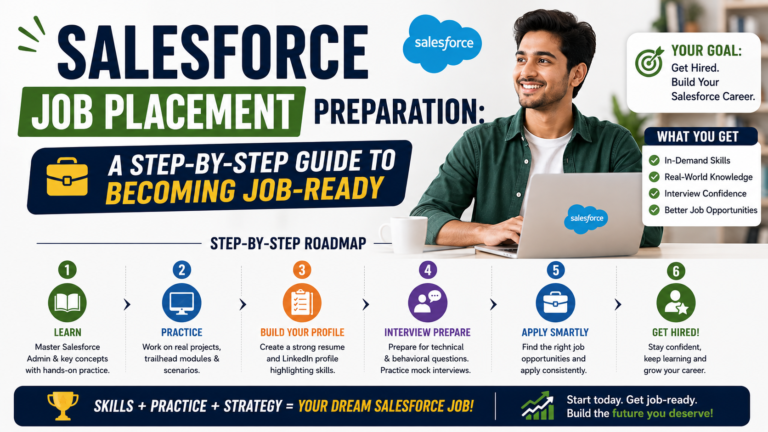
Salesforce Job Placement Preparation: A Step-by-Step Guide to Becoming Job-Ready
Learning Salesforce is an excellent first step toward building a career in the cloud technology and CRM industry. However, completing a Salesforce course is only one part of the journey. The next challenge is getting shortlisted, performing well in interviews, and proving that you can apply your knowledge in a professional environment.
Many freshers and beginners struggle during the placement process because they focus mainly on completing the syllabus. They may understand Salesforce concepts but find it difficult to explain projects, answer scenario-based questions, prepare a professional resume, or communicate confidently with recruiters.
This is why **Salesforce placement preparation** is so important.
A structured placement-focused learning approach combines technical training with practical projects, resume preparation, mock interviews, communication skills, certification guidance, and job support.
This guide explains how you can prepare for Salesforce placements step by step and improve your chances of becoming job-ready.
—
# What Does Salesforce Placement Preparation Include?
Placement preparation is more than simply searching for job openings.
It includes:
* Technical skill development
* Practical project experience
* Resume preparation
* Interview practice
* Communication improvement
* Certification guidance
* Career mentoring
* Job application support
The goal is to help candidates confidently participate in the hiring process.
—
# Step 1: Build Strong Salesforce Fundamentals
Before preparing for interviews, make sure your Salesforce foundation is strong.
Important topics include:
* CRM Concepts
* Salesforce Navigation
* Standard Objects
* Custom Objects
* Fields
* Relationships
* Page Layouts
* Record Types
Strong fundamentals help you answer both basic and scenario-based interview questions.
—
# Step 2: Master Salesforce Administration
Administration is an important foundation for many Salesforce careers.
Prepare topics such as:
* User Management
* Profiles
* Permission Sets
* Roles
* Sharing Rules
* Data Management
* Reports
* Dashboards
* Validation Rules
Don’t just memorize definitions. Practice configuring these features in a Salesforce environment.
—
# Step 3: Learn Salesforce Automation
Automation is one of the most important skills recruiters may evaluate.
Focus on:
* Record-Triggered Flows
* Screen Flows
* Scheduled Flows
* Approval Processes
* Automation Scenarios
For example, practice creating a Flow that automatically updates a record when a specific business condition is met.
Practical examples make interview answers stronger.
—
# Step 4: Work on Realistic Projects
Projects are extremely useful during placements because recruiters often ask candidates to explain their experience.
Build projects such as:
### Sales Management System
Manage leads, accounts, contacts, and opportunities.
### Customer Support System
Create and manage customer cases, priorities, and service processes.
### Employee Management System
Manage employee information, departments, leave requests, and approvals.
During interviews, be prepared to explain:
* Business requirement
* Salesforce solution
* Features used
* Automation
* Challenges
* Your contribution
—
# Step 5: Learn Development Skills
If you’re targeting Salesforce Developer roles, strengthen your technical skills.
Important topics include:
* Apex
* Apex Classes
* Triggers
* SOQL
* Collections
* Exception Handling
* Test Classes
Practice solving small business problems using Apex instead of only studying syntax.
—
# Step 6: Learn Lightning Web Components
Lightning Web Components are an important part of modern Salesforce development.
Prepare:
* HTML
* JavaScript
* Component Structure
* Data Binding
* Events
* Apex Integration
Build simple components and gradually move toward more advanced applications.
—
# Step 7: Understand Salesforce Integration
For advanced roles, integration knowledge can be valuable.
Learn the basics of:
* REST API
* SOAP API
* JSON
* OAuth
* API Testing
Understanding how Salesforce communicates with external systems helps you handle enterprise-level scenarios.
—
# Step 8: Prepare Your Salesforce Resume
Your resume should make your Salesforce skills easy to understand.
Include:
* Professional Summary
* Salesforce Skills
* Certifications
* Projects
* Technical Skills
* Education
* Relevant Experience
For freshers, projects can play an important role in demonstrating practical knowledge.
Avoid adding technologies you cannot explain during an interview.
—
# Step 9: Prepare for Salesforce Certifications
Certifications can strengthen your professional profile.
Beginners commonly start with:
* Salesforce Certified Administrator
As your skills develop, you can explore certifications related to:
* Development
* Consulting
* Data
* AI
* Industry solutions
Certification should be supported by hands-on practice.
—
# Step 10: Practice Technical Interviews
Technical preparation should include both conceptual and scenario-based questions.
Examples:
* What is a custom object?
* What is the difference between a profile and permission set?
* How does a record-triggered Flow work?
* What is a validation rule?
* How do sharing rules work?
* What is SOQL?
* When would you use Apex?
Don’t simply memorize answers. Understand why and when each feature is used.
—
# Step 11: Prepare for HR Interviews
HR rounds are equally important.
Prepare for questions such as:
* Tell me about yourself.
* Why did you choose Salesforce?
* Why should we hire you?
* What are your strengths?
* What are your career goals?
* Are you comfortable learning new technologies?
Keep your answers honest, professional, and concise.
—
# Step 12: Improve Communication Skills
A candidate may have excellent Salesforce knowledge but still struggle if they cannot explain their ideas clearly.
Practice:
* Self-introduction
* Project explanation
* Technical explanations
* Group discussions
* Mock interviews
Good communication helps recruiters understand your actual capabilities.
—
# Common Placement Mistakes
Avoid these mistakes during your job search:
### Only Studying Theory
Practical experience is essential.
### Applying Without Preparation
Research the role before attending interviews.
### Not Understanding Your Resume
Be prepared to explain everything written on your resume.
### Memorizing Answers
Interviewers may change the wording of questions.
### Ignoring Communication
Technical skills and communication should develop together.
### Giving Up After Rejections
Every interview provides an opportunity to identify areas for improvement.
—
# How to Handle Interview Rejection
Rejection doesn’t mean you are not capable of building a Salesforce career.
After an unsuccessful interview, review:
* Which questions were difficult?
* Did you explain your project properly?
* Were you confident?
* Did you understand the technical concepts?
* Was your communication clear?
Use the experience to improve your next attempt.
—
# Build a Consistent Placement Routine
A simple daily routine can include:
**30 minutes:** Salesforce theory
**30 minutes:** Hands-on practice
**30 minutes:** Project development
**20 minutes:** Interview questions
**10 minutes:** English communication practice
Consistency is more important than studying for long hours occasionally.
—
# Why Choose Prabh Kirpa Classes?
Prabh Kirpa Classes focuses on combining Salesforce training with career-oriented preparation.
Students receive training in:
* Salesforce Administration
* Salesforce Development
* Lightning Web Components
* Salesforce Integration
* OmniStudio
* Practical Assignments
* Live Projects
* Certification Guidance
* Resume Building
* Mock Interviews
* Job Support
The objective is to help learners develop the technical and professional skills required to approach Salesforce job opportunities with confidence.
—
# Frequently Asked Questions
### Can freshers get Salesforce jobs?
Yes. Freshers can pursue entry-level Salesforce opportunities by developing strong fundamentals, practical skills, projects, and interview readiness.
### Is certification enough for placement?
Certification can strengthen your profile, but practical knowledge, projects, communication, and interview performance are also important.
### How important are Salesforce projects?
Projects are highly useful because they demonstrate that you can apply Salesforce concepts to practical business situations.
### Does placement support guarantee a job?
No training or placement support can guarantee selection. Placement assistance is intended to improve preparation, job readiness, and access to relevant opportunities.
—
# Conclusion
Getting a Salesforce job requires more than completing a training course. Candidates need a combination of technical knowledge, hands-on experience, communication skills, a professional resume, and interview preparation.
A structured placement preparation plan helps you identify skill gaps, build practical projects, prepare for technical and HR interviews, and approach recruiters with greater confidence.
At **Prabh Kirpa Classes**, learners receive Salesforce training along with practical assignments, live projects, certification guidance, resume preparation, mock interviews, and job support. With consistent practice and the right preparation strategy, you can take a confident step toward starting your Salesforce career.
Newsletter
Recent Posts
Salesforce Job Placement Preparation: A Step-by-Step Guide to Becoming Job-Ready
Learning Salesforce is an excellent first step toward building a
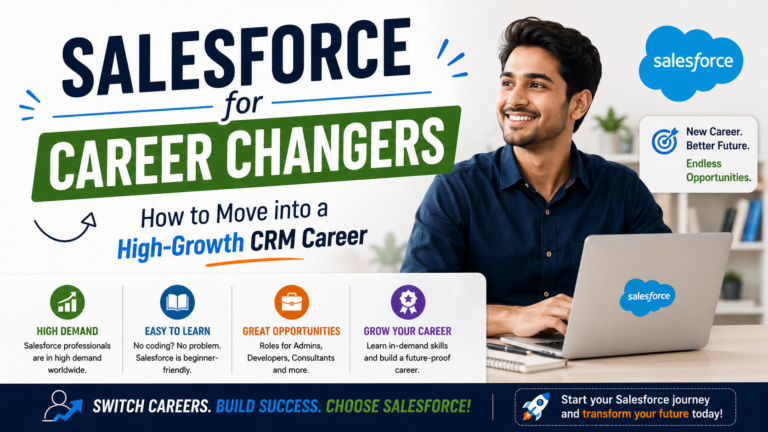
Salesforce for Career Changers: How to Move into a High-Growth CRM Career
Changing careers can feel challenging, especially when you have already
Bharat Life Sciences Award 2026: Excellence in Which Field?
The newly launched Bharat Life Sciences Award 2026 recognizes excellence
India’s U20 Athletics Team Captain Revealed | World Athletics U20 Championships
Who has been named the captain of India’s 36-member contingent