
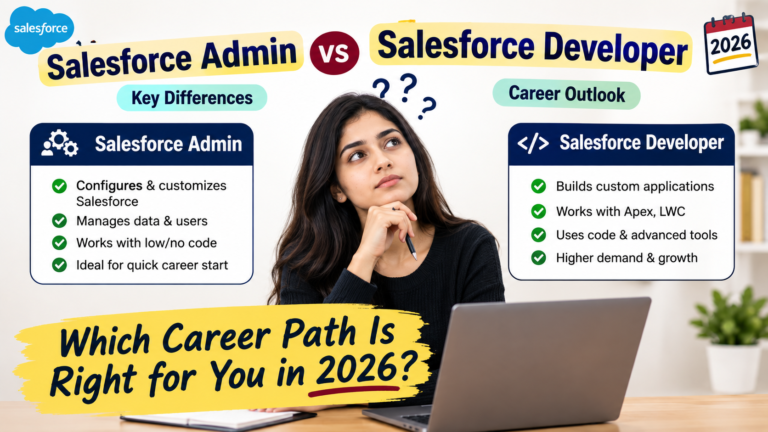
Salesforce Admin vs Salesforce Developer: Which Career Path Is Right for You in 2026?
Introduction
Salesforce has become an important platform for organizations that want to manage customers, automate business processes, analyze data, and build customized applications. As the Salesforce ecosystem continues to expand, more students, freshers, and working professionals are exploring Salesforce as a career option.
However, beginners often face an important question:
Should I become a Salesforce Administrator or a Salesforce Developer?
Both career paths can lead to opportunities in the Salesforce ecosystem, but the skills, responsibilities, and learning approaches are different.
A Salesforce Administrator generally focuses on configuring and managing the Salesforce platform, while a Salesforce Developer works more deeply with programming and customized solutions.
Understanding the difference can help you choose a learning path that matches your interests, background, and career goals.
What Is a Salesforce Administrator?
A Salesforce Administrator manages and configures Salesforce according to an organization’s requirements.
Administrators may work with:
Users
Profiles
Permission Sets
Objects
Fields
Security
Data
Reports
Dashboards
Automation
Flows
Their job is often focused on making Salesforce useful and efficient for business teams.
For example, a sales team may need a new process for tracking opportunities. An Administrator can configure Salesforce to support that process.
What Does a Salesforce Administrator Do?
A Salesforce Administrator may be responsible for tasks such as:
User Management
Creating users and managing their access.
Security
Configuring profiles, permission sets, roles, and sharing settings.
Data Management
Importing, updating, cleaning, and maintaining Salesforce data.
Reports and Dashboards
Creating reports that help managers understand business performance.
Automation
Using Flow Builder to automate repetitive business processes.
Platform Support
Helping users understand and effectively use Salesforce.
What Is a Salesforce Developer?
A Salesforce Developer focuses on creating customized technical solutions on the Salesforce platform.
Developers may work with:
Apex
SOQL
Lightning Web Components
APIs
Integrations
Custom applications
Test Classes
When a business requirement cannot be handled effectively through standard configuration, development may be required.
What Does a Salesforce Developer Do?
A Salesforce Developer may:
Write Apex code
Build custom functionality
Create Lightning Web Components
Develop integrations
Work with APIs
Create automated tests
Troubleshoot technical issues
Customize Salesforce applications
Developers often work closely with Administrators, Consultants, Business Analysts, and other technical teams.
Salesforce Admin vs Developer: Key Difference
The simplest way to understand the difference is:
Administrator → Configuration & Business Processes
Developer → Programming & Customization
However, there can be overlap between the two roles.
Modern Salesforce professionals may need to understand both configuration and development concepts.
Skills Required for Salesforce Administrator
If you’re interested in Administration, focus on:
Salesforce Fundamentals
CRM Concepts
Objects and Fields
Relationships
Data Management
Security
Reports
Dashboards
Validation Rules
Flow Builder
User Management
You should also develop:
Problem-solving skills
Business understanding
Communication skills
Requirement analysis
Skills Required for Salesforce Developer
For Development, learn:
Salesforce Fundamentals
Apex
SOQL
Triggers
Classes
Test Classes
Lightning Web Components
JavaScript
HTML
APIs
Integration Concepts
Developers also need strong programming and debugging skills.
Do Salesforce Administrators Need Coding?
Not necessarily.
A beginner can start learning Salesforce Administration without extensive programming knowledge.
Many administrative tasks can be completed using configuration tools.
However, learning basic programming concepts can still be useful as your career develops.
Do Salesforce Developers Need Administration Knowledge?
Yes, understanding Administration concepts can be extremely valuable for Developers.
A Developer should understand:
Salesforce data models
Security
Objects
Relationships
User access
Automation
This allows developers to build solutions that work correctly within the Salesforce environment.
Which Career Is Easier for Beginners?
For many beginners, Salesforce Administration can be a more approachable starting point because it allows learners to understand the platform before moving into programming.
A typical learning progression could be:
Salesforce Fundamentals → Administration → Flow → Projects → Development
However, learners who already enjoy programming may prefer starting with a development-oriented path after building the necessary Salesforce foundation.
Which Career Is Better?
There is no universal answer.
The better career depends on your interests.
Choose Administration if you enjoy:
Business processes
Configuration
Data
User management
Problem-solving
Working with business teams
Choose Development if you enjoy:
Coding
Programming
Technical problem-solving
Building applications
APIs
Custom solutions
Both paths can be valuable within the Salesforce ecosystem.
Can You Move from Admin to Developer?
Yes.
In fact, understanding Administration can provide a useful foundation before learning development.
For example:
Administration
↓
Data & Security
↓
Flow
↓
Apex & SOQL
↓
Lightning Web Components
↓
Integration
This creates a gradual technical learning path.
Importance of Practical Projects
Whether you’re preparing for an Admin or Developer role, projects are important.
Admin Project
Build an employee management system using:
Custom Objects
Fields
Relationships
Validation Rules
Flows
Reports
Dashboards
Developer Project
Build a customized application using:
Apex
SOQL
LWC
Custom Objects
Apex Controllers
Projects help you understand how Salesforce features work together.
Certification and Salesforce Careers
Certifications can help demonstrate your knowledge.
Beginners can explore certifications aligned with their chosen career path, while experienced professionals can pursue more specialized credentials.
However, certification should not be treated as a substitute for practical experience.
A strong profile can combine:
Certification + Projects + Practical Skills + Communication + Interview Preparation
How to Prepare for Salesforce Interviews
Whether you’re targeting an Admin or Developer role, interview preparation should include both technical and practical questions.
Administrator Questions
What is a Profile?
What is a Permission Set?
What is a Role?
What are Sharing Rules?
What is a Validation Rule?
What is Flow?
How does Data Loader work?
Developer Questions
What is Apex?
What is SOQL?
What is a Trigger?
What are Governor Limits?
What are Test Classes?
What is LWC?
How does Apex interact with LWC?
Scenario-based questions should also be part of your preparation.
Don’t Ignore Communication Skills
Salesforce professionals frequently communicate with business users and technical teams.
You may need to:
Understand requirements
Explain technical solutions
Discuss projects
Present ideas
Participate in meetings
Answer interview questions
Technical knowledge becomes much more valuable when you can explain it clearly.
A Practical Salesforce Career Roadmap
If you’re completely new to Salesforce, consider this structured approach:
Stage 1 — Salesforce Basics
Understand CRM, cloud computing, objects, fields, and relationships.
Stage 2 — Administration
Learn security, data, reports, dashboards, and configuration.
Stage 3 — Automation
Develop Flow Builder skills.
Stage 4 — Practical Projects
Build realistic business applications.
Stage 5 — Career Direction
Choose Administration, Development, Consulting, Integration, or another specialization.
Stage 6 — Advanced Skills
For Developers, learn Apex, SOQL, LWC, and integrations.
Stage 7 — Career Preparation
Work on your resume, certification preparation, mock interviews, and job support.
Common Mistakes Salesforce Beginners Should Avoid
Trying to Learn Everything at Once
Salesforce is a large ecosystem. Follow a structured roadmap.
Focusing Only on Certification
Understand practical concepts instead of studying only for an exam.
Ignoring Projects
Projects help convert theoretical knowledge into practical skills.
Jumping into Advanced Coding Too Early
Build your Salesforce foundation first.
Not Understanding Business Requirements
Salesforce is ultimately used to solve business problems.
Why Choose Prabh Kirpa Classes?
Prabh Kirpa Classes provides structured Salesforce training for learners who want to develop practical skills and prepare for Salesforce career opportunities.
Training areas include:
Salesforce Administration
Salesforce Development
Flow Builder
Apex
Lightning Web Components
Salesforce Integration
OmniStudio
Practical Assignments
Live Projects
Certification Guidance
Resume Preparation
Mock Interviews
Job Support
The focus is on combining technical learning with practical experience and career preparation.
Frequently Asked Questions
Is Salesforce Admin good for beginners?
Yes. Administration provides a strong foundation for understanding Salesforce and can be a practical starting point for beginners.
Is Salesforce Developer a coding job?
Yes. Developer roles generally involve programming using technologies such as Apex and JavaScript, along with Salesforce-specific development tools.
Can a non-technical person learn Salesforce?
Yes. Beginners from different educational backgrounds can start with Salesforce fundamentals and Administration before progressing to advanced technical skills.
Which is better: Salesforce Admin or Developer?
Neither is universally better. The right choice depends on whether you prefer business configuration and processes or programming and technical development.
Can I learn both?
Yes. Learning both Administration and Development can provide a broader understanding of the Salesforce platform.
Conclusion
Salesforce Administration and Salesforce Development are two important career paths within the Salesforce ecosystem. Administration focuses primarily on configuration, security, data, reporting, and automation, while Development involves programming, custom applications, integrations, and advanced technical solutions.
If you’re a beginner, starting with Salesforce fundamentals and Administration can help you understand the platform before moving into advanced development. If you already enjoy programming, you can gradually build toward Apex, SOQL, LWC, and integration.
The most important thing is to choose a structured learning path and combine theoretical knowledge with practical projects.
At Prabh Kirpa Classes, learners can develop Salesforce Administration, Development, Flow, LWC, Integration, and OmniStudio skills along with project experience, certification guidance, interview preparation, and job support.
Choose your path. Build practical skills. Prepare for your Salesforce career.
Newsletter
Recent Posts
Salesforce Integration Explained: How Salesforce Connects with Other Business Systems
Introduction Modern businesses rarely use only one software application. A
Salesforce Admin vs Salesforce Developer: Which Career Path Is Right for You in 2026?
Introduction Salesforce has become an important platform for organizations that

András Baka Elected President of Hungary | Hungary New President 2026 | Daily Current Affairs
András Baka has been elected as the new President of
India Achieves 20% Ethanol Blending | ESY 2025-26 | Daily Current Affairs MCQ
India achieved the 20% ethanol blending target in petrol during