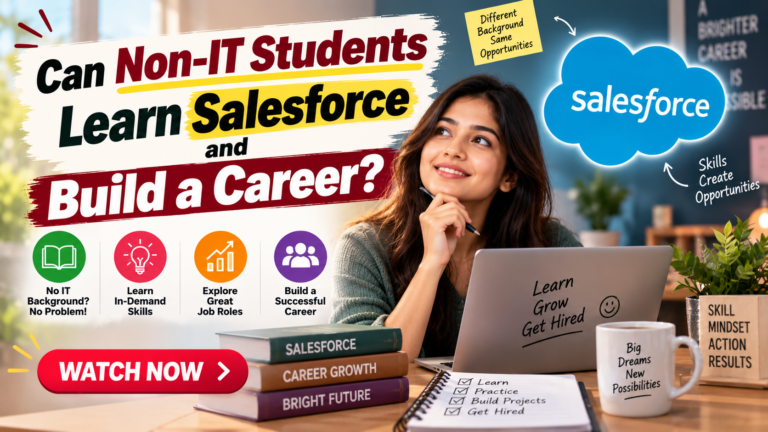
Can Non-IT Students Learn Salesforce and Build a Career?
Choosing a career in technology can feel difficult when your educational background is not related to IT. Students from commerce, management, arts, or other non-technical backgrounds often wonder whether they can enter the technology industry without knowing programming or having a computer science degree.
One technology career that many beginners consider is Salesforce.
But the important question is: **Can non-IT students learn Salesforce and actually build a career with it?**
The short answer is **yes**.
You don’t necessarily need a computer science degree to start learning Salesforce. What matters more is your willingness to learn, your understanding of business processes, and your ability to develop practical Salesforce skills.
Let’s understand how a non-IT student can approach a Salesforce career.
## What Is Salesforce?
Salesforce is a cloud-based Customer Relationship Management (CRM) platform used by businesses to manage their relationships and interactions with customers.
Companies use Salesforce for activities such as:
* Managing leads and customers
* Tracking sales opportunities
* Handling customer service cases
* Creating reports and dashboards
* Automating business processes
* Managing customer data
* Connecting different business applications
Because Salesforce combines technology with business processes, you don’t have to be a programmer to understand its basic concepts.
This makes the platform approachable for beginners from different educational backgrounds.
## Do You Need an IT Degree to Learn Salesforce?
No.
An IT or computer science degree can certainly be useful for some technical Salesforce roles, but it isn’t a mandatory starting point for learning the platform.
For example, Salesforce Administration focuses heavily on configuration, data management, security, reporting, automation, and understanding business requirements.
A student from commerce or management may already be familiar with concepts such as customers, sales, business operations, and reporting.
These concepts can make some parts of Salesforce easier to understand.
What you need is the willingness to learn how those business processes are implemented inside Salesforce.
## Which Salesforce Path Is Best for Non-IT Students?
For most beginners without a technical background, **Salesforce Administration** is a sensible place to start.
A Salesforce Administrator works with the configuration and management of the Salesforce platform.
You may learn topics such as:
* Objects and fields
* Accounts and contacts
* Leads and opportunities
* Reports and dashboards
* Profiles and permission sets
* Roles and sharing
* Data management
* Validation rules
* Automation
* Approval processes
These concepts don’t require advanced programming knowledge.
Once you become comfortable with Salesforce, you can decide whether you want to continue with Administration or move toward a more technical path.
## Can a Non-IT Student Become a Salesforce Developer?
Yes, but the learning path will be more technical.
Salesforce Development involves programming concepts and technologies such as:
* Apex
* SOQL
* SOSL
* JavaScript
* Lightning Web Components
* APIs
* Integrations
* Test classes
If you have never programmed before, these topics may take more time to learn.
That doesn’t mean they are impossible.
You simply need to build your technical foundation gradually instead of trying to learn everything at once.
A practical progression can be:
**Salesforce Fundamentals → Administration → Programming Basics → Apex → SOQL → LWC → Integration**
This approach allows you to understand the Salesforce platform before moving into advanced development.
## Why Non-IT Students Can Have an Advantage
A non-technical background isn’t always a disadvantage.
Salesforce is used to solve business problems, not just technical problems.
Someone who understands business operations, communication, sales, finance, customer service, or management may already have useful knowledge.
For example, a commerce student may understand:
* Sales processes
* Business reporting
* Customer relationships
* Financial terminology
* Business operations
A management student may be comfortable with:
* Business requirements
* Team coordination
* Process management
* Communication
* Customer-facing activities
These skills can be valuable when working with Salesforce because Salesforce professionals often need to understand what a business actually wants before configuring or developing a solution.
## What Should Non-IT Students Learn First?
If you’re completely new to Salesforce, avoid jumping directly into advanced development.
Start with the basics.
### 1. Learn CRM Fundamentals
Understand what CRM means and how companies manage customers.
Learn concepts such as:
* Lead
* Account
* Contact
* Opportunity
* Case
* Sales process
* Customer service
### 2. Learn Salesforce Administration
Once you understand CRM, start learning Salesforce configuration.
Focus on:
* Objects
* Fields
* Relationships
* Security
* Profiles
* Permission Sets
* Reports
* Dashboards
* Data management
* Automation
### 3. Practice on Salesforce
Don’t depend only on videos or notes.
Create your own small Salesforce projects.
For example, imagine that you are setting up Salesforce for a small company.
You could create:
**Leads → Accounts → Contacts → Opportunities**
Then build reports and dashboards to track sales performance.
This kind of practice helps you understand how Salesforce works in real situations.
### 4. Decide Your Career Direction
After learning the fundamentals, decide what interests you.
You could continue toward:
* Salesforce Administrator
* Salesforce Business Analyst
* Salesforce Consultant
* Salesforce Developer
* Salesforce LWC Developer
* Salesforce Integration
* Salesforce Support
You don’t have to choose everything immediately.
## Is Coding Necessary for a Salesforce Career?
Not for every Salesforce role.
This is an important distinction.
Salesforce Administration can be learned without becoming an advanced programmer.
However, if you want to become a Salesforce Developer, you will eventually need programming knowledge.
So, don’t let the fear of coding stop you from starting.
Begin with the non-coding areas of Salesforce and gradually introduce programming if your career goal requires it.
## How Long Does It Take to Learn Salesforce?
There isn’t a fixed timeline for everyone.
Your learning speed will depend on your educational background, previous experience, available study time, and career goal.
Someone studying Salesforce consistently every day may progress faster than someone who studies only occasionally.
A beginner can follow a structured roadmap:
**Month 1: Salesforce Fundamentals & Administration**
Learn CRM concepts, objects, fields, security, reports, dashboards, data management, and automation.
**Month 2: Advanced Administration & Projects**
Work on practical scenarios, automation, reporting, security, and Salesforce projects.
**After Fundamentals: Development**
If you want a technical career, move into Apex, SOQL, LWC, APIs, and integration.
The exact timeline can vary, but consistency is more important than trying to finish everything quickly.
## Do Salesforce Certifications Matter?
Certifications can help demonstrate your knowledge and may strengthen your resume.
For someone starting out, a relevant Salesforce certification can provide a structured learning goal.
However, don’t depend entirely on certification.
Employers may also want to know whether you can:
* Understand requirements
* Solve practical problems
* Explain Salesforce concepts
* Configure the platform
* Work with data
* Troubleshoot issues
* Communicate effectively
That’s why combining **certification + hands-on practice + project experience** is a better approach.
## Can Freshers Get Salesforce Jobs?
Freshers can pursue Salesforce-related opportunities, but getting the first job usually requires more than completing a course.
Build a strong foundation and work on practical projects.
Your resume can include projects demonstrating that you know how to configure Salesforce and solve common business scenarios.
You should also prepare for interviews.
Instead of memorizing hundreds of definitions, practice scenario-based questions.
For example:
**”How would you restrict users from editing certain records?”**
or
**”How would you automate a process when a particular field changes?”**
Understanding the reasoning behind the solution is much more useful than simply memorizing an answer.
## What Skills Should Non-IT Students Develop?
Salesforce knowledge is important, but don’t ignore your soft skills.
Try to improve:
* Communication
* Problem-solving
* Logical thinking
* Business understanding
* Documentation
* Team collaboration
* Requirement gathering
* Presentation skills
These skills can become particularly useful in Salesforce roles where you interact with users, clients, managers, or development teams.
## Common Mistakes Beginners Should Avoid
Non-IT students often make a few common mistakes when starting Salesforce.
### Trying to Learn Everything at Once
Salesforce is a huge ecosystem.
You don’t need to learn every product immediately.
Start with the fundamentals and build from there.
### Focusing Only on Theory
Watching tutorials isn’t enough.
Practice what you learn.
### Ignoring Business Concepts
Salesforce is designed around business proc
Newsletter
Recent Posts
Can Non-IT Students Learn Salesforce and Build a Career?
Choosing a career in technology can feel difficult when your

Salesforce Career in 2026: Skills, Job Roles, Salary & How to Start
Salesforce has become one of the most widely used CRM
PM Modi Highlights Global Expansion of UPI in 11 Countries | Current Affairs
Q7. PM Narendra Modi recently highlighted the global expansion of
Is Prior Human Rights Commission Inquiry Mandatory Before Approaching Human Rights Court?
Q6. According to the Supreme Court’s recent ruling, is a