
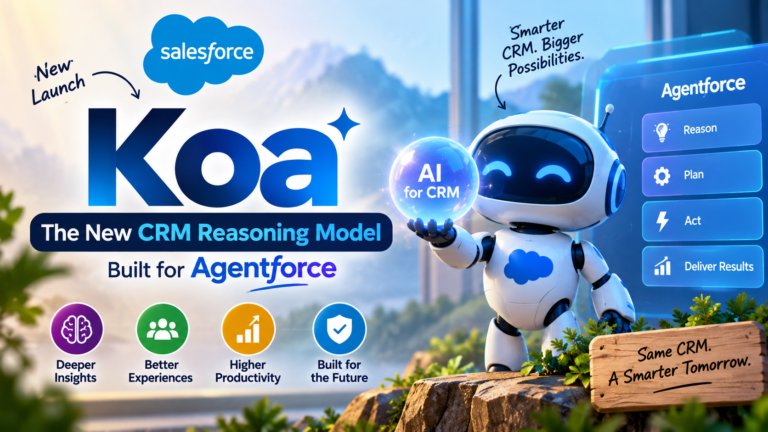
Salesforce Koa: The New CRM Reasoning Model Built for Agentforce
Artificial intelligence is rapidly changing how businesses use CRM platforms. Salesforce has been investing heavily in AI-powered agents through Agentforce, and its latest announcement takes that strategy a step further.
On September 15, 2026, Salesforce and NVIDIA announced **Koa, Salesforce’s first CRM reasoning model for Agentforce**, built on NVIDIA Nemotron. Koa is designed specifically for enterprise CRM work, with the goal of helping AI agents reason through complex, multi-step business processes and select the appropriate tools and actions.
Unlike a general-purpose AI model, Koa has been specifically developed around CRM workflows and enterprise business processes. Salesforce says the model incorporates knowledge from nearly three decades of CRM deployments and has been trained using synthetic scenarios representing enterprise workflows across more than 14 industries.
For Salesforce professionals, developers, administrators, and businesses exploring Agentforce, Koa represents an important development in the evolution from traditional CRM automation toward AI-powered, agentic CRM.
## What Is Salesforce Koa?
**Salesforce Koa is a CRM-focused reasoning model designed to power Agentforce agents.**
It is built on **NVIDIA Nemotron 3 Super** and post-trained by Salesforce using synthetic enterprise scenarios designed around CRM reasoning, tool usage, and decision-making.
The purpose of Koa is not simply to generate text.
Instead, it is designed to help an AI agent understand a business objective, reason through multiple steps, choose appropriate tools, and take actions within a CRM workflow.
For example, consider a sales scenario:
A customer asks for an updated proposal.
An AI agent may need to:
1. Identify the customer.
2. Retrieve the relevant opportunity.
3. Check the opportunity stage.
4. Review previous interactions.
5. Determine the appropriate next action.
6. Update Salesforce records.
7. Schedule a follow-up.
8. Communicate the result to the user.
These are multi-step tasks rather than simple question-and-answer interactions.
Koa is designed to help Agentforce handle this type of reasoning and tool use more effectively.
## Why Does Salesforce Need a CRM Reasoning Model?
Traditional AI models are designed to work across many different domains.
They can write an email, summarize information, answer questions, generate code, and perform many other tasks.
However, enterprise CRM workflows can be much more structured.
A CRM system contains:
* Customer records
* Leads
* Accounts
* Opportunities
* Cases
* Sales processes
* Service workflows
* Business rules
* Permissions
* Automation
* Industry-specific processes
An AI agent working inside this environment needs to understand not only language but also **business processes and sequences of actions**.
Salesforce describes Koa as a model specifically optimized for enterprise work, rather than relying entirely on a general-purpose model for CRM reasoning.
This is an important distinction.
### General AI vs. CRM Reasoning AI
A general AI model might understand:
> “The customer wants a follow-up.”
A CRM reasoning model needs to go further:
> Who is the customer?
> Which opportunity is involved?
> What is the current opportunity stage?
> What action should happen next?
> Which Salesforce tool should be used?
> What record needs to be updated?
That difference is at the heart of Salesforce’s approach with Koa.
## How Was Koa Built?
Salesforce and NVIDIA collaborated to build Koa using **NVIDIA Nemotron** as the foundation.
Salesforce post-trained NVIDIA Nemotron 3 Super using a proprietary synthetic dataset designed to represent enterprise CRM scenarios.
The training scenarios were designed around:
* Reasoning
* Tool use
* Decision-making
* Multi-step workflows
* CRM actions
* Business processes
Salesforce says the scenarios cover more than **14 industries**, including manufacturing, financial services, healthcare, and travel.
The company also used techniques including **Supervised Fine-Tuning (SFT)** and reinforcement learning with **Group Relative Policy Optimization (GRPO)** during post-training.
The objective was to teach the model not only to produce an appropriate response, but also to reason through the actions required to accomplish an enterprise task.
## Does Salesforce Use Customer Data to Train Koa?
This is one of the most important questions for organizations considering AI.
According to Salesforce, **customer data was not used to train Koa**.
Salesforce says the training corpus was created entirely from synthetic scenarios representing CRM workflows.
This approach allows Salesforce to train the model around enterprise processes without using customer data as its training corpus.
Salesforce also says Koa runs within its own infrastructure and that customer data does not cross the Salesforce trust boundary during training or inference.
## What Can Koa Help Agentforce Do?
Koa is intended to support a range of CRM tasks performed by Agentforce.
These can include workflows involving:
### Sales
AI agents can work with processes such as:
* Lead generation
* Lead qualification
* Opportunity updates
* Follow-ups
* Sales workflows
### Customer Service
Koa can support reasoning around:
* Customer cases
* Case routing
* Service workflows
* Customer interactions
* Follow-up actions
### Employee Workflows
Salesforce is also using Koa across different Agentforce use cases, including employee, help, event, and web agents.
The important concept is that Koa is designed to support the reasoning layer behind these agent experiences.
## Koa and Agentforce: How Are They Connected?
It is important to understand that **Koa and Agentforce are not the same thing**.
Think of them as different parts of an AI system.
**Agentforce** is Salesforce’s platform for building and deploying AI agents.
**Koa** is a specialized reasoning model that can provide the reasoning capabilities used by those agents.
A simplified view looks like this:
**User → Agentforce Agent → Koa Reasoning Model → Salesforce Tools/Data → Action**
For example:
A sales manager asks:
> “Find the opportunities that need follow-up and schedule the next action.”
The Agentforce agent can interpret the request, while Koa can help reason through the required steps and tool calls.
The agent can then work with the appropriate Salesforce records and actions.
## Koa’s Reported Performance
Salesforce reports that Koa has demonstrated improvements on its CRM Bench across specific CRM use cases.
According to Salesforce’s Koa product page, the model showed:
* **11% greater precision** in calling the correct action
* **2.1× greater reliability** in recalling customer context
* **15% better performance** in remembering context during long conversations
Salesforce also reported in its announcement that Koa matched or exceeded leading model performance on certain CRM actions while producing three times fewer errors in its CRM benchmark.
These are **Salesforce-reported benchmark results**, so they should be understood within the company’s own testing methodology rather than treated as a universal comparison across every AI workload.
## Why NVIDIA Nemotron Matters
NVIDIA plays an important role in the development of Koa.
Koa was built using **NVIDIA Nemotron**, an open-model family that gave Salesforce greater control over the model’s post-training and deployment.
This matters because Salesforce is not simply connecting an external general-purpose AI model to CRM data.
Instead, Salesforce has used an open-model foundation and customized it for CRM reasoning.
The partnership combines:
**Salesforce CRM expertise + NVIDIA AI models + Salesforce Agentforce**
This creates a model specifically targeted at enterprise CRM workflows.
## Koa and Data Security
Enterprise AI adoption depends heavily on security and governance.
Salesforce says Koa is designed to operate within the Salesforce trust boundary and that Salesforce controls the model weights and infrastructure used for the model.
Salesforce also says Koa is hosted with controls intended to make responses consistent and operates with additional trust and safety mechanisms.
For organizations dealing with sensitive customer information, these considerations can be particularly important when evaluating AI agents.
## What Does Koa Mean for Salesforce Administrators?
Salesforce Admin roles are changing as AI becomes increasingly integrated into CRM platforms.
Admins traditionally work with areas such as:
* Objects and fields
* Security
* Reports
* Dashboards
* Flows
* Automation
* Data management
* User management
With Agentforce and models such as Koa becoming part of the Salesforce ecosystem, understanding **AI-powered automation** is becoming increasingly relevant.
Admins may need to understand how AI agents interact with:
* Salesforce data
* Flows
* Actions
* Permissions
* Business rules
* Data Cloud
* Agentforce
* AI models
The role is not simply disappearing because AI exists. Instead, the skill set is expanding toward managing and governing intelligent automation.
## What Does Koa Mean for Salesforce Developers?
For Salesforce developers, Koa is also significant.
Developers may increasingly work with AI-powered applications that combine:
* Apex
* Lightning Web Components
* APIs
* Flow
* Agentforce
* Data Cloud
* AI models
* Salesforce security
Instead of building every automation from scratch, developers may increasingly design systems where AI agents can reason through tasks and invoke appropriate actions.
This makes knowledge of **AI + Salesforce development** an increasingly relevant skill combination.
## Koa vs. Traditional Salesforce Automation
Traditional automation follows predefined rules.
For example:
**If Opportunity Stage = Closed Won → Create Follow-Up Task**
The logic is explicitly defined.
AI reasoning introduces another layer.
An agent may receive a broader objective and determine a sequence of actions based on available context, tools, and instructions.
A simplified comparison:
| Traditional Automation | AI Agent with Reasoning |
| ———————– | ————————– |
| Rule-based | Goal-oriented |
| Predefined conditions | Multi-step reasoning |
| Fixed workflow | Can select actions |
| Requires explicit logic | Uses model reasoning |
| Predictable sequence | Context-dependent sequence |
This does not mean traditional automation becomes irrelevant.
In many enterprise environments, deterministic automation and AI agents can work together.
## Koa and the Future of CRM
Koa is part of a broader shift in Salesforce toward what the company calls an **agentic enterprise**.
Instead of CRM being primarily a database and user interface, AI agents can increasingly interact with business data, workflows, tools, and processes.
Salesforce’s recent announcements around Agentforce, AIforce, and Koa show how the company is developing this broader direction.
The long-term concept is straightforward:
**CRM + Data + AI + Automation + Agents**
Together, these technologies can enable organizations to move from simply storing customer information toward systems that can assist with or execute business processes.
## When Will Salesforce Koa Be Available?
Salesforce announced Koa as available to **select pilot customers**, with general availability expected in **winter 2026 in U.S. regions**.
Salesforce also says Koa can be selected as a managed model in its generative AI models catalogue and used within Agentforce at different levels, including agents and sub-agents.
Availability can change, so organizations should check Salesforce’s current documentation before planning production deployments.
## Should Salesforce Professionals Learn About Koa?
Koa is still a new development, but the concepts behind it are highly relevant to Salesforce professionals.
If you’re preparing for a Salesforce career in 2026, consider building knowledge across several areas:
1. Salesforce Administration
2. Salesforce Flow
3. Apex
4. Lightning Web Components
5. Data Cloud
6. Agentforce
7. AI fundamentals
8. Prompt and agent design
9. Salesforce security and governance
10. AI-powered automation
The key takeaway is not simply to learn one new AI model.
The bigger opportunity is understanding **how Salesforce CRM, data, automation, and AI agents work together**.
## Final Thoughts
Salesforce Koa marks another step in the company’s move toward specialized AI for CRM.
Built with NVIDIA Nemotron and trained using synthetic scenarios representing decades of Salesforce CRM knowledge, Koa is designed to help Agentforce agents handle complex, multi-step enterprise workflows.
Its significance goes beyond another AI model announcement.
The development highlights a broader trend: **AI models are becoming increasingly specialized for particular industries, workflows, and business tasks.**
For Salesforce professionals, this means the future of CRM skills may increasingly involve a combination of traditional Salesforce expertise and AI knowledge.
Understanding Salesforce Admin, Flow, Apex, Data Cloud, Agentforce, and AI concepts together can help professionals better understand where the Salesforce ecosystem is heading.
**Salesforce Koa is not simply about generating better answers. It is about enabling AI agents to reason through CRM work and take the appropriate actions.**
That shift—from answering questions to reasoning and acting—is one of the most important developments to watch in Salesforce’s AI evolution in 2026.
### Key Takeaways
* Koa is Salesforce’s first CRM reasoning model for Agentforce.
* It was announced with NVIDIA on September 15, 2026.
* Koa is built on NVIDIA Nemotron 3 Super.
* Salesforce says it was trained using synthetic CRM scenarios rather than customer data.
* Its scenarios cover more than 14 industries.
* Koa is designed for complex, multi-step enterprise workflows.
* Salesforce says the model runs within its trust boundary.
* Koa can be used with Agentforce agents and sub-agents.
* Select customers can currently pilot Koa.
* General availability is expected in winter 2026 in U.S. regions.
Newsletter
Recent Posts
Salesforce Koa: The New CRM Reasoning Model Built for Agentforce
Artificial intelligence is rapidly changing how businesses use CRM platforms.

Trump Warns EU Over Canada’s Proposed Associate Membership 🇺🇸🇨🇦🇪🇺 | Current Affairs 2026
U.S. President Donald Trump warned the European Union of potential
West Bengal Bypolls 2026: ECI Bans TMC Name & Symbol | Current Affairs MCQ
In today’s Current Affairs 2026 MCQ, we cover an important
Trump Warns EU Over Canada’s Associate Membership | Current Affairs MCQ 2026
In today’s Current Affairs 2026, we cover an important international