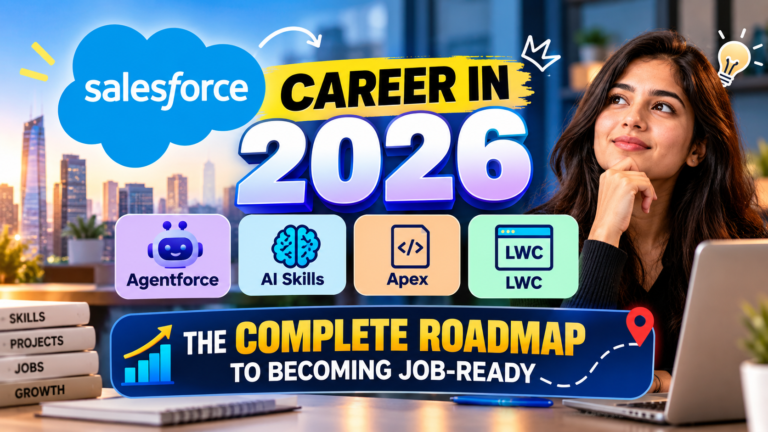
Salesforce Career in 2026: Agentforce, AI Skills, Apex, and LWC — The Complete Roadmap to Becoming Job-Ready
The technology industry is evolving rapidly, and artificial intelligence is changing how businesses manage customers, automate processes, and develop software. In this environment, Salesforce professionals are increasingly working with CRM configuration, business automation, application development, data management, and AI-powered tools.
One of the major developments in the Salesforce ecosystem is **Agentforce**, Salesforce’s platform for building AI agents. Salesforce’s 2026 developer updates also highlight Agentforce, Data 360, Apex, Lightning Web Components (LWC), and expanded API-based development capabilities. These developments make AI integration and automation relevant topics for Salesforce learners. [Source: Salesforce Developers](https://developer.salesforce.com/blogs/2026/06/the-salesforce-developers-guide-to-the-summer-26-release)
For beginners, this creates an opportunity to build practical technical skills instead of focusing only on theoretical knowledge.
Whether you are a fresher, a graduate exploring IT careers, or a working professional planning a career transition, learning Salesforce can help you develop skills that apply to real business problems.
In this guide, we will explore Salesforce career paths, important technical skills, Agentforce, practical projects, and a step-by-step learning roadmap for 2026.
## 1. What Is Salesforce?
Salesforce is a cloud-based customer relationship management (CRM) platform that helps businesses manage customer information, sales activities, service requests, marketing processes, and business workflows.
Organizations use Salesforce to centralize customer data, improve team collaboration, automate repetitive tasks, and understand business performance.
The Salesforce ecosystem includes several products and technologies, such as:
* Sales Cloud for sales processes and opportunity management.
* Service Cloud for customer support and case management.
* Experience Cloud for digital customer and partner experiences.
* Salesforce Flow for automating business processes.
* Apex for server-side business logic.
* Lightning Web Components for building interactive user interfaces.
* Agentforce for developing AI agents.
* Data 360 for connecting and using data across business experiences.
You do not need to learn every product at the beginning. Start with the Salesforce platform fundamentals and select a learning path based on your interests.
## 2. Why Salesforce Skills Are Evolving in 2026
Salesforce learning now extends beyond basic CRM configuration. Professionals may need to understand how data, automation, application development, and AI work together.
Here are four important areas to explore.
### AI and Agentforce
Agentforce enables organizations to create AI agents that can support tasks and business workflows. Learning how agents use instructions, available data, actions, and defined business rules can help you understand AI-powered Salesforce solutions.
### Low-Code Automation
Salesforce Flow allows administrators and developers to automate processes with visual tools. Record-triggered flows, scheduled flows, screen flows, and approval-related processes are useful areas to study.
### Custom Application Development
Apex and Lightning Web Components help developers build functionality that goes beyond standard Salesforce configuration.
### Data and Integration
Real business applications often exchange information with external systems. Understanding objects, relationships, APIs, authentication concepts, and data quality provides a foundation for integration work.
These areas are complementary. AI does not remove the need to understand business requirements, data access, testing, and reliable automation.
## 3. Salesforce Admin vs Salesforce Developer: Which Path Should You Learn?
Two common entry points into the Salesforce ecosystem are administration and development.
| Salesforce Admin | Salesforce Developer |
| ———————————————— | ———————————————————– |
| Focuses on configuration and system management | Focuses on custom functionality and application development |
| Learns objects, fields, permissions, and reports | Learns data models, Apex, SOQL, and LWC |
| Builds automation using Salesforce Flow | Builds complex logic using code and automation |
| Manages users, access, and business processes | Develops integrations, components, and advanced solutions |
| Works closely with business teams | Works closely with technical and business teams |
**Which should you choose?**
If you enjoy configuring systems, solving business problems, and working with business users, explore the Admin path first.
If you enjoy programming, debugging, and building applications, explore the Developer path.
You can also begin with Salesforce fundamentals and Flow before choosing a specialization. Both paths benefit from an understanding of CRM data, security, and business requirements.
## 4. Essential Salesforce Skills to Learn in 2026
### A. Salesforce Admin Fundamentals
Begin with the platform’s basic building blocks:
* Standard and custom objects
* Fields and field types
* Record relationships
* Page layouts and Lightning record pages
* Profiles, permission sets, and role hierarchy
* Reports and dashboards
* Validation rules
* Data import and export
These concepts explain how Salesforce stores information, controls access, and supports business processes.
### B. Salesforce Flow and Automation
Automation is a valuable skill for both administrators and developers.
Focus on:
* Record-triggered flows
* Screen flows
* Scheduled-triggered flows
* Decision and assignment elements
* Loops and collections
* Fault paths and error handling
* Debugging and testing
Practice creating flows that automate lead assignment, follow-up reminders, case escalation, and record updates.
### C. Apex Programming
Apex is Salesforce’s programming language for implementing server-side business logic.
Learn the following topics in sequence:
1. Variables and data types
2. Conditional statements and loops
3. Lists, sets, and maps
4. SOQL and SOSL
5. DML operations
6. Classes and methods
7. Triggers and trigger handlers
8. Exception handling and governor limits
9. Test classes and asynchronous Apex
Start with small programs and gradually build more complex functionality.
### D. Lightning Web Components (LWC)
LWC is a modern framework for developing custom user interfaces on Salesforce.
Important topics include JavaScript fundamentals, HTML, CSS, component structure, properties, events, data binding, Lightning Data Service, and communication between components.
Build simple components first, such as a searchable contact list or a form that creates a record.
### E. Agentforce and AI Fundamentals
After learning the platform basics, explore Agentforce and AI-powered business workflows.
Understand how to define an agent’s purpose, provide relevant instructions, connect approved data sources, configure actions, establish guardrails, and test expected and unexpected scenarios.
Also learn why access controls, data privacy, human review, and reliable execution matter when AI interacts with business systems.
For current platform capabilities, consult the [official Salesforce Agentforce resources](https://www.salesforce.com/agentforce/).
## 5. How to Learn Salesforce from Scratch: A Practical Roadmap
If you are new to Salesforce, follow a structured learning sequence rather than trying to study every technology simultaneously.
### Phase 1: Learn CRM and Salesforce Fundamentals
**Suggested duration: Weeks 1–2**
Understand CRM concepts, Salesforce navigation, objects, fields, records, relationships, and basic configuration.
Practice creating a simple data model for a fictional company.
### Phase 2: Learn Administration and Flow
**Suggested duration: Weeks 3–5**
Work on permissions, validation rules, reports, dashboards, and Flow automation.
Create a lead-management process that assigns incoming leads and schedules follow-up activities.
### Phase 3: Learn Development Fundamentals
**Suggested duration: Weeks 6–9**
Study programming fundamentals, Apex, SOQL, DML, classes, triggers, and test classes.
Build functionality that validates records and automates a business process.
### Phase 4: Learn LWC and Integrations
**Suggested duration: Weeks 10–12**
Create reusable Lightning Web Components and learn how Salesforce components interact with records and server-side logic.
Explore API concepts and integration fundamentals.
### Phase 5: Explore Agentforce and Build Projects
**Suggested duration: Weeks 13–16**
Learn the relevant Agentforce concepts and develop a small AI-assisted workflow where supported by your Salesforce environment.
Test the solution, document its behavior, and explain its limitations.
These timelines are illustrative, not guarantees of job readiness. Your progress will depend on your prior experience, practice time, and the complexity of the projects you build.
## 6. Five Salesforce Projects to Build for Your Portfolio
Practical projects can help demonstrate that you understand how Salesforce concepts work together.
### Project 1: Lead Management System
Create a lead-management solution with custom fields, validation rules, assignment logic, reports, and dashboards.
**Skills demonstrated:** Salesforce Admin, data modeling, Flow, reporting.
### Project 2: Automated Case Management
Build a customer support workflow that assigns cases, updates priority, sends notifications, and escalates unresolved cases according to defined conditions.
**Skills demonstrated:** Service Cloud concepts, Flow, business logic, troubleshooting.
### Project 3: Apex-Based Business Automation
Develop Apex classes and triggers to enforce business rules, prevent invalid updates, and manage related records.
Include meaningful test classes and demonstrate how the code handles bulk record operations.
**Skills demonstrated:** Apex, SOQL, DML, testing, governor limits.
### Project 4: Custom LWC Dashboard
Create a custom Lightning Web Component that displays selected business metrics or a searchable list of records.
Focus on a clear interface, reusable code, error handling, and appropriate access controls.
**Skills demonstrated:** JavaScript, LWC, Salesforce data access.
### Project 5: Agentforce-Assisted Customer Support
Design a sample workflow in which an AI agent helps answer customer questions using approved knowledge sources and supports permitted actions.
Document the agent’s scope, test cases, escalation rules, and situations requiring human intervention.
**Skills demonstrated:** Agentforce concepts, business process design, data governance, testing.
For every project, maintain a short description of the business problem, your implementation, the technologies used, and the results observed in your test environment.
## 7. Salesforce Certifications to Consider
Certifications can help structure your learning and demonstrate knowledge of a particular Salesforce role.
Depending on your chosen path, research these credentials:
* Salesforce Certified Administrator
* Salesforce Certified Platform App Builder
* Salesforce Certified Platform Developer I
* Salesforce Certified Platform Developer II
* Relevant Salesforce AI or Agentforce credentials available for your target role
Check the official [Salesforce Credentials website](https://trailhead.salesforce.com/credentials/) for current certification names, exam requirements, preparation resources, and available credentials.
A certification is not a substitute for hands-on experience. Combine your preparation with practice exercises, projects, and an understanding of real business requirements.
## 8. Salesforce Career Opportunities and Salary Factors
Salesforce professionals may work in roles such as:
* Salesforce Administrator
* Salesforce Developer
* Salesforce Consultant
* Salesforce Business Analyst
* Salesforce QA or Test Engineer
* Salesforce Integration Developer
* Salesforce Technical Lead
* Salesforce Architect
* Agentforce or Salesforce AI Solution Specialist
The responsibilities and entry requirements vary by employer.
Salary depends on several factors, including experience, location, technical specialization, communication skills, certifications, project experience, and the employer’s requirements.
Rather than relying on a single salary figure, compare current job listings for your location and experience level. Review the skills employers repeatedly request, then use those requirements to guide your learning plan.
Freshers should focus on platform fundamentals, practical projects, interview preparation, and the ability to explain their work clearly. Working professionals can map their existing technical or business experience to a relevant Salesforce specialization.
## 9. How to Prepare for Salesforce Interviews
Interview preparation should include both theoretical questions and practical exercises.
Review questions such as:
* What is the difference between a standard object and a custom object?
* What is the difference between a profile and a permission set?
* What are the different types of Salesforce Flow?
* What is the difference between SOQL and SOSL?
* What are Apex triggers, and when should they be used?
* What are governor limits?
* How do you write an Apex test class?
* What is Lightning Web Components?
* How do you troubleshoot a failed flow?
* What should you consider before connecting an AI agent to business data?
Practice explaining the reasoning behind your answers. For scenario-based questions, describe the business requirement, the solution you would choose, alternative approaches, security considerations, and how you would test the implementation.
Also prepare to demonstrate at least two projects that you built or configured yourself.
## 10. Common Mistakes Salesforce Beginners Should Avoid
**Learning too many technologies at once:** Build a strong foundation before moving between Admin, Apex, LWC, integrations, and AI.
**Memorizing answers without practice:** Use a Developer Edition or other appropriate learning environment to test concepts.
**Ignoring security:** Understand permissions, record access, data visibility, and secure development practices.
**Skipping testing:** Learn how to debug Flows, write Apex tests, and validate application behavior.
**Treating AI as a replacement for fundamentals:** Agentforce solutions still require clear requirements, reliable data, appropriate access controls, and testing.
**Building no portfolio:** Document projects that demonstrate your ability to solve specific business problems.
## 11. Where Can You Learn Salesforce?
Salesforce learners can use a combination of official learning resources, guided training, and hands-on practice.
Start with [Salesforce Trailhead](https://trailhead.salesforce.com/), which provides learning modules and guided exercises.
For additional structure, consider a training program that covers Salesforce Admin, Flow and Automation, Apex, LWC, project development, and interview preparation.
At **Prabh Kirpa Classes**, learners can explore Salesforce training topics covering administration, development, Apex, LWC, Flow, and automation, with learning support for freshers and working professionals.
When comparing training options, review the curriculum, practical exercises, instructor experience, project work, and the support available for your learning goals.
Choose a learning approach that gives you enough practice to explain and demonstrate the skills you acquire.
## Conclusion: Build Your Salesforce Skills for the AI Era
A Salesforce career in 2026 can involve much more than configuring a CRM. Administration, automation, Apex, LWC, data integration, and Agentforce provide different ways to develop useful business technology skills.
The key is to build your knowledge progressively: understand the platform, practice automation, choose a specialization, complete realistic projects, and learn how to test and explain your solutions.
You do not need to master every Salesforce technology at once. Start with the fundamentals, establish a consistent practice routine, and expand your skills as your projects become more advanced.
**Ready to start learning Salesforce?** Explore the available training topics at Prabh Kirpa Classes and begin building practical skills for your Salesforce learning journey.
—
## Frequently Asked Questions (FAQs)
### 1. Is Salesforce suitable for beginners in 2026?
Yes. Beginners can start with CRM fundamentals and Salesforce administration before progressing to automation, development, or AI-related capabilities.
### 2. Should I learn Salesforce Admin or Developer first?
Choose Admin if you prefer configuration and business processes. Choose Developer if you enjoy programming. Learning the common platform fundamentals first can help you make an informed choice.
### 3. Is Apex still useful with the growth of AI?
Apex remains relevant for implementing custom server-side logic, integrations, and business rules. AI tools can assist development, but understanding code, testing, and platform limits remains important.
### 4. What is Agentforce in Salesforce?
Agentforce is Salesforce’s platform for building and deploying AI agents that can assist with tasks and business workflows. Its appropriate use depends on the business requirement, configuration, available data, and permissions.
### 5. How long does it take to learn Salesforce?
The time required varies according to prior experience, study time, and the chosen role. A structured learning plan with regular hands-on practice can help learners track their progress.
### 6. Do Salesforce certifications guarantee a job?
No. Certifications can demonstrate knowledge, but hiring decisions also depend on practical skills, communication, experience, projects, and employer requirements.
### 7. Can working professionals learn Salesforce?
Yes. Working professionals can study alongside their current responsibilities by following a structured learning plan and practicing consistently.
### 8. What is the best way to prepare for Salesforce interviews?
Study core concepts, solve scenario-based questions, practice in a Salesforce environment, and prepare to explain your own projects, design decisions, and testing approach.
Newsletter
Recent Posts
Salesforce Career in 2026: Agentforce, AI Skills, Apex, and LWC — The Complete Roadmap to Becoming Job-Ready
The technology industry is evolving rapidly, and artificial intelligence

9th India International Water Week 2026 | Climate Resilient Water Management | Current Affairs MCQ
Test your knowledge with this important Current Affairs MCQ on

India FY27 Gross Market Borrowing Target | Government Borrowing Calendar H2 | Current Affairs MCQ
Test your knowledge with this important Economy Current Affairs MCQ

RBI State of the Economy Review | Crude Oil Prices & Imported Inflation | Current Affairs MCQ
Test your knowledge with this important Current Affairs MCQ based