
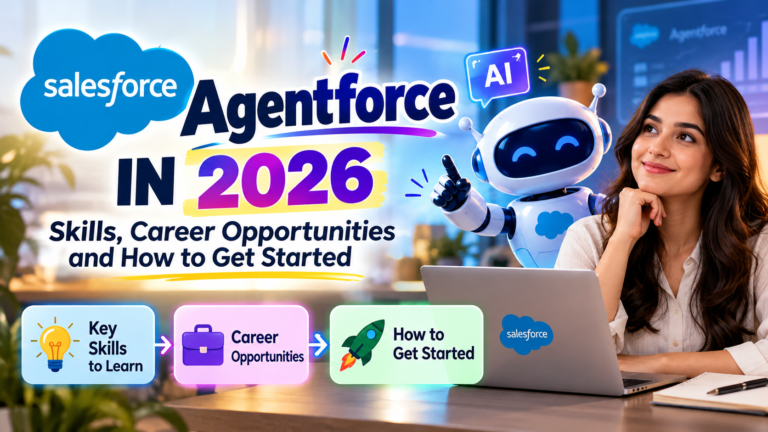
Salesforce Agentforce in 2026: Skills, Career Opportunities, and How to Get Started
Salesforce is evolving beyond traditional CRM software, and artificial intelligence is becoming an increasingly important part of the ecosystem. One of the technologies attracting attention is Salesforce Agentforce, which enables businesses to build AI agents that can assist with tasks, respond to requests, and support business workflows.
For students, freshers, Salesforce administrators, and developers, understanding Agentforce can be a valuable step toward expanding their Salesforce skills.
But what exactly is Agentforce? How does it work? Which skills should you learn? And how can you begin building practical experience?
In this guide, Prabh Kirpa Classes explains the fundamentals of Salesforce Agentforce, its key capabilities, the skills to develop, and a practical learning roadmap for 2026.
## What Is Salesforce Agentforce?
Salesforce Agentforce is Salesforce’s platform for building and managing AI agents that can assist with business tasks using company data, defined instructions, and available actions.
Unlike a traditional chatbot that primarily responds to predefined questions, an AI agent can be designed to handle more complex interactions by selecting appropriate actions within its configured scope.
For example, a business might use an AI agent to help customers track an order, answer product questions, or initiate a service request. Depending on the implementation, the agent may retrieve information, invoke an action, or hand the conversation to a human employee.
The agent’s capabilities depend on its configuration, available data, permissions, and the actions it is authorised to perform.
## How Does Salesforce Agentforce Work?
Agentforce implementations bring together several important components.
### 1. Topics and instructions
Topics help define the kinds of tasks an agent should handle. Instructions guide the agent’s behaviour and help establish the boundaries of its responsibilities.
For example, a customer service agent may be configured to answer order-related questions rather than provide unrelated information.
### 2. Actions
Actions allow an agent to perform supported operations. Depending on the setup, these may involve Salesforce Flow, Apex, or other supported integrations.
For example, an agent could invoke a Flow designed to retrieve order details or initiate a service process.
### 3. Data and knowledge
An agent needs relevant information to respond effectively. Salesforce records, approved knowledge content, and supported data integrations can provide context for its work.
The quality, accessibility, and security of that information influence the usefulness of the resulting experience.
### 4. Testing and supervision
Agents should be tested against realistic scenarios before deployment. Businesses must also consider permissions, data access, error handling, monitoring, and human escalation.
AI capabilities should be introduced with appropriate safeguards rather than assuming that every response or action will be correct.
## Salesforce Agentforce vs Traditional Salesforce Automation
Agentforce and Salesforce automation tools can complement each other, but they serve different purposes.
| Feature | Salesforce Flow | Salesforce Agentforce |
|—|—|—|
| Primary purpose | Automate defined business processes | Build AI agents for supported business tasks |
| Execution | Follows configured automation logic | Uses agent instructions and reasoning to select supported actions |
| Best suited for | Predictable, rule-based workflows | Interactions that require flexible handling within defined boundaries |
| Common example | Update a record when a condition is met | Help a customer with a service request |
| Relationship | Can provide actions used in an agent workflow | Can invoke supported automation actions when configured |
**Which should you learn first?**
If you are a beginner, start with Salesforce fundamentals, objects, fields, relationships, and Flow. Once you understand how Salesforce data and automation work, explore Agentforce and learn how agents can use supported actions.
Developers can extend this foundation with Apex, integrations, and relevant AI concepts.
## Why Should Salesforce Professionals Learn Agentforce in 2026?
AI is changing how organisations approach customer service, sales support, internal operations, and business process automation. Understanding AI-enabled Salesforce capabilities can help professionals participate in projects that combine CRM data, automation, and intelligent user experiences.
Potential benefits include:
– Expanding your understanding of modern Salesforce capabilities.
– Learning how AI agents interact with CRM data and business processes.
– Building projects that demonstrate automation and AI-related skills.
– Developing a broader understanding of the Salesforce ecosystem.
– Preparing to discuss AI-enabled CRM solutions in technical interviews.
However, learning Agentforce does not guarantee a job or a salary increase. Career outcomes depend on practical ability, relevant experience, communication skills, market demand, and the requirements of individual employers.
## Skills You Should Learn Before Agentforce
You do not need to master every Salesforce technology before exploring Agentforce. However, a solid foundation will help you understand real-world implementations.
### 1. Salesforce CRM fundamentals
Learn how Salesforce stores and manages business information.
Focus on:
– Standard and custom objects
– Fields and relationships
– Record types and page layouts
– Reports and dashboards
– Profiles, permission sets, and data access
These concepts help you understand the records and permissions that AI-enabled solutions may use.
### 2. Salesforce Flow
Flow is an important automation skill for administrators and developers.
Practise:
– Record-triggered flows
– Screen flows
– Decision elements
– Get Records and Update Records
– Fault paths and error handling
– Subflows and reusable automation
Understanding Flow can help you build business actions that may be used as part of a larger Agentforce implementation.
### 3. Apex fundamentals
If you want to move toward Salesforce development, learn Apex programming.
Important topics include:
– Variables and data types
– Classes and methods
– SOQL and DML
– Triggers and bulkification
– Exception handling
– Test classes
Apex can help implement custom business logic where declarative automation is not sufficient.
### 4. Data security and permissions
Security is essential when working with customer information. Learn how Salesforce permissions, record access, and data protection affect what users and automated processes can access.
Do not assume that an AI agent should have unrestricted access to CRM records.
### 5. Agentforce concepts
Once you understand the fundamentals, explore the available Agentforce configuration tools and documentation.
Learn about agent instructions, topics, supported actions, grounding, testing, and the controls used to manage agent behaviour.
Salesforce features and product terminology can change, so consult current official documentation while learning.
## A Practical 30-Day Salesforce Agentforce Learning Roadmap
Here is a sample learning plan for beginners and Salesforce professionals who want to explore Agentforce.
### Week 1: Strengthen Salesforce fundamentals
– Review objects, fields, and relationships.
– Practise creating and updating records.
– Understand reports, dashboards, and permissions.
– Build a small CRM example using sample data.
### Week 2: Learn Salesforce Flow
– Create a record-triggered Flow.
– Build a Screen Flow.
– Add decision logic and fault handling.
– Test the automation with different scenarios.
### Week 3: Explore Agentforce
– Learn the basic architecture and terminology.
– Explore agent instructions and supported actions.
– Understand how agents can use Flow or Apex actions where supported.
– Study data access, testing, and escalation requirements.
### Week 4: Build and document a project
– Choose a simple business use case.
– Create the required Salesforce data structure.
– Configure an appropriate automation or agent workflow.
– Test normal, unexpected, and unauthorised requests.
– Document the architecture, functionality, limitations, and results.
Use a Salesforce environment and features that are currently available to you. Some capabilities may require specific editions, licences, permissions, or setup.
## Project Idea: AI-Powered Customer Support Assistant
A practical project can help you connect theory with implementation.
### Project objective
Create a customer support experience that helps users obtain order information and initiate appropriate service requests.
### Suggested workflow
1. A customer asks about an order or service issue.
2. The agent identifies the request within its configured scope.
3. It retrieves permitted information or invokes an approved action.
4. A Flow or Apex action performs the required operation when appropriate.
5. The agent provides a response based on the result.
6. Requests that cannot be handled safely are escalated to a human.
### Technologies to explore
– Salesforce CRM objects
– Salesforce Flow
– Agentforce configuration
– Apex, where custom logic is needed
– Salesforce permissions and access controls
– Testing and documentation
Use fictional or approved sample data while learning. Avoid exposing personal customer information in a public portfolio.
### How to present the project on your resume
Describe what you actually built, which technologies you used, and how you tested the result.
For example:
“Developed a Salesforce customer support prototype using CRM records, Flow automation, and configured AI-agent actions. Documented workflow behaviour, permission requirements, error handling, and escalation scenarios.”
Only include technologies and functionality you genuinely implemented. Be prepared to explain the design decisions during an interview.
## Salesforce Agentforce Career Opportunities
Agentforce-related knowledge may be relevant to several Salesforce career paths, depending on the role and employer requirements.
**Salesforce Administrator:** Manages CRM configuration, permissions, reports, and declarative automation.
**Salesforce Developer:** Builds custom business logic, integrations, and application functionality using tools such as Apex and Lightning Web Components.
**Salesforce Consultant:** Helps organisations understand business requirements and design suitable Salesforce solutions.
**Salesforce Technical Architect:** Designs larger solutions involving data, security, integrations, automation, and system architecture. These positions generally require substantial experience.
**AI and CRM Solution Specialist:** Helps evaluate and implement AI-enabled CRM experiences, subject to the employer’s specific role definition.
Beginners should focus on developing transferable Salesforce skills rather than relying on one product name alone.
## Common Mistakes to Avoid When Learning Agentforce
### Mistake 1: Skipping Salesforce fundamentals
AI features are easier to understand when you know how Salesforce data, access controls, and business processes work.
### Mistake 2: Learning only definitions
Reading documentation is useful, but practical configuration and testing are necessary to build confidence.
### Mistake 3: Ignoring security
Agents and actions must be designed with appropriate permissions and safeguards.
### Mistake 4: Building a project without testing
Test successful scenarios, missing data, invalid requests, access restrictions, and escalation behaviour.
### Mistake 5: Overstating your skills on your resume
Clearly distinguish between concepts you have studied, projects you have built, and technologies you have used professionally.
## Frequently Asked Questions
### 1. Is Salesforce Agentforce suitable for beginners?
Yes, beginners can explore Agentforce. However, learning Salesforce CRM fundamentals and basic automation first can make the concepts easier to understand.
### 2. Do I need to learn Apex before Agentforce?
Not necessarily. Some implementations can use supported declarative actions. Apex becomes useful when a project requires custom logic or functionality that declarative tools cannot adequately provide.
### 3. Is Agentforce replacing Salesforce Flow?
Agentforce and Flow serve different purposes. Flow is useful for defined automation logic, while Agentforce supports AI-agent experiences. They can work together in an appropriate implementation.
### 4. Can learning Agentforce help me get a Salesforce job?
It may strengthen your profile when combined with core Salesforce skills and demonstrable projects. Employment depends on your overall preparation, practical experience, interview performance, and market conditions.
### 5. What project should I build first?
Start with a small customer support or service-request use case. Focus on data structure, permissions, supported actions, testing, and clear documentation before adding complexity.
### 6. Where should I learn the latest Agentforce features?
Use Salesforce’s official documentation, release notes, and available learning resources. Product capabilities and prerequisites may change, so verify the current requirements before building a project.
## Conclusion
Salesforce Agentforce is an important area to explore as CRM platforms continue incorporating AI into business workflows. For aspiring administrators and developers, the best starting point is a strong foundation in Salesforce fundamentals, automation, data security, and practical project development.
Build one project at a time, test your work carefully, and document what you learn. A combination of core Salesforce knowledge and hands-on experience can help you prepare for a wider range of opportunities in the evolving Salesforce ecosystem.
**Want to strengthen your Salesforce skills?** Explore the Salesforce learning resources from Prabh Kirpa Classes and work toward building practical, job-relevant skills.
Newsletter
Recent Posts
Salesforce Agentforce in 2026: Skills, Career Opportunities, and How to Get Started
Salesforce is evolving beyond traditional CRM software, and artificial
National Testing Agency NTA Report MCQ 2026 | Important Current Affairs
Prepare for competitive exams with this important Current Affairs MCQ

Can You Guess the NTA Reform Report Number? 🎓🔥 | Current Affairs Q10
Current Affairs Q10 🎓🇮🇳 Can you guess the correct report
Government Scheme First Anniversary 2026 MCQ | 100 Priority Agricultural Districts
Test your knowledge with this important October 2026 Current Affairs