
Daily Economy Current Affairs 2026: Latest Business, Banking and Finance News
In today’s rapidly evolving world, economic developments influence every aspect of our lives. From interest rates and inflation to stock markets and digital banking, economic decisions impact businesses, governments, and individuals alike. For aspirants preparing for UPSC, SSC, Banking, Railway, Insurance, Defence, and State Government examinations, staying updated with daily economy current affairs is no longer optional—it’s essential.
Economic current affairs form a significant part of competitive exams and help candidates understand how policies, financial institutions, markets, and global events shape economic growth. At Prabh Kirpa Classes, we provide exam-oriented economy current affairs covering business, banking, finance, taxation, government schemes, and international economic developments.
Why Economy Current Affairs Are Important?
The economy affects employment, investments, prices, government spending, and business growth. Competitive examinations frequently include questions related to recent economic developments because they reflect a candidate’s awareness of the country’s financial health.
Benefits of Studying Economy Current Affairs
- Improves General Awareness scores.
- Helps in Banking and Insurance examinations.
- Strengthens UPSC Economy preparation.
- Enhances interview performance.
- Develops analytical thinking.
- Improves understanding of national and global markets.
- Helps in essay and descriptive writing.
Candidates who regularly follow economic developments often perform better in competitive examinations and interviews.
Understanding the Indian Economy
India is one of the fastest-growing major economies in the world. The country’s economy is driven by agriculture, manufacturing, services, technology, and infrastructure development.
Key Sectors of the Economy
Agriculture Sector
Agriculture remains one of the largest employment-generating sectors in India.
Important topics include:
- Minimum Support Price (MSP)
- PM Kisan Samman Nidhi
- Crop Insurance Schemes
- Agricultural Exports
- Food Security Programs
Government initiatives aimed at increasing farmer income frequently appear in current affairs.
Manufacturing Sector
The manufacturing sector contributes significantly to economic growth and employment generation.
Major initiatives:
- Make in India
- Production Linked Incentive (PLI) Scheme
- Startup India
- Atmanirbhar Bharat
These programs aim to boost domestic production and reduce dependency on imports.
Service Sector
The service sector contributes the highest share to India’s GDP.
Major industries include:
- Information Technology
- Banking
- Tourism
- Healthcare
- Education
- E-Commerce
The growth of India’s digital economy has further strengthened the service sector.
GDP and Economic Growth
What is GDP?
Gross Domestic Product (GDP) measures the total value of goods and services produced within a country during a specific period.
GDP is considered one of the most important indicators of economic performance.
Importance of GDP
- Measures economic growth.
- Indicates national productivity.
- Helps investors evaluate economic strength.
- Guides government policymaking.
A growing GDP generally reflects a healthy economy, while slower growth may indicate economic challenges.
Inflation and Price Stability
Inflation is one of the most discussed topics in economy current affairs.
What is Inflation?
Inflation refers to the rise in the prices of goods and services over time.
Types of Inflation
- Demand-Pull Inflation
- Cost-Push Inflation
- Core Inflation
- Food Inflation
Effects of Inflation
Positive Effects:
- Encourages investment.
- Supports business expansion.
Negative Effects:
- Reduces purchasing power.
- Increases cost of living.
- Impacts household savings.
The Reserve Bank of India continuously monitors inflation and takes corrective measures when required.
Reserve Bank of India (RBI)
The Reserve Bank of India is India’s central bank and plays a crucial role in maintaining economic stability.
Major Functions of RBI
- Conducts Monetary Policy.
- Controls Inflation.
- Issues Currency.
- Regulates Banks.
- Manages Foreign Exchange Reserves.
- Maintains Financial Stability.
Questions related to RBI are commonly asked in Banking, SSC, and UPSC examinations.
Important RBI Terms
Repo Rate
Repo Rate is the interest rate at which RBI lends money to commercial banks.
Impact
- Higher Repo Rate reduces inflation.
- Lower Repo Rate promotes economic growth.
Reverse Repo Rate
The rate at which RBI borrows money from commercial banks.
Purpose
- Controls excess liquidity.
- Helps manage inflation.
Cash Reserve Ratio (CRR)
The percentage of deposits that banks must keep with RBI.
Benefits
- Controls money supply.
- Maintains financial stability.
Statutory Liquidity Ratio (SLR)
The percentage of deposits banks must maintain in liquid assets.
These concepts are highly important for competitive exams.
Banking Sector Developments
India’s banking sector continues to evolve rapidly through reforms and technological advancements.
Major Banking Trends
- Digital Banking
- Mobile Banking
- UPI Transactions
- Internet Banking
- Financial Inclusion
- Banking Mergers
The growth of fintech companies has transformed the banking landscape.
Digital Banking Revolution
Digital banking has become one of the strongest pillars of India’s economy.
Key Innovations
- UPI Payments
- QR Code Payments
- Digital Wallets
- Mobile Banking Apps
- Contactless Payments
India now leads the world in digital payment transactions.
Benefits
- Faster Transactions
- Financial Inclusion
- Reduced Cash Dependency
- Improved Transparency
Digital banking frequently appears in current affairs and banking exams.
Union Budget and Economic Planning
The Union Budget is among the most important economic events every year.
Components of Budget
- Revenue Receipts
- Capital Receipts
- Fiscal Deficit
- Government Expenditure
- Taxation Measures
Why Budget Matters?
The budget impacts:
- Economic Growth
- Employment
- Infrastructure Development
- Social Welfare Programs
Questions from budget announcements are commonly asked in competitive exams.
Taxation System in India
Taxes are the primary source of government revenue.
Direct Taxes
Collected directly from individuals and businesses.
Examples:
- Income Tax
- Corporate Tax
Indirect Taxes
Collected indirectly through consumption.
Example:
- Goods and Services Tax (GST)
Goods and Services Tax (GST)
GST unified India’s indirect tax system and simplified taxation.
Advantages of GST
- Reduced Tax Complexity
- Improved Compliance
- Enhanced Transparency
- Better Revenue Collection
GST-related updates are important topics for SSC, Banking, and UPSC exams.
Stock Market and Financial Markets
The stock market reflects the economic confidence of investors.
Major Stock Exchanges
- Bombay Stock Exchange (BSE)
- National Stock Exchange (NSE)
Key Market Indices
- Sensex
- Nifty 50
Importance
- Facilitates Capital Formation
- Encourages Investment
- Reflects Economic Sentiment
Candidates should regularly follow market-related current affairs.
Foreign Exchange Reserves
Forex reserves are foreign currency assets maintained by the Reserve Bank of India.
Importance
- Supports International Trade
- Maintains Currency Stability
- Strengthens Investor Confidence
India’s foreign exchange reserves are often highlighted in economic current affairs.
International Economic Organizations
Several global institutions influence economic policies and international trade.
International Monetary Fund (IMF)
Provides financial support and policy guidance to member countries.
World Bank
Funds development and infrastructure projects worldwide.
World Trade Organization (WTO)
Promotes international trade and resolves trade disputes.
Asian Development Bank (ADB)
Supports economic development across Asia.
Questions related to these organizations frequently appear in exams.
Government Economic Schemes
Government schemes play a crucial role in economic development.
PM Vishwakarma Scheme
Supports traditional artisans and craftsmen.
Startup India
Promotes entrepreneurship and innovation.
Stand-Up India
Supports entrepreneurship among women and marginalized groups.
PM Mudra Yojana
Provides financial assistance to small businesses.
PM Gati Shakti
Improves logistics and infrastructure development.
Aspirants should understand the objectives and benefits of these schemes.
Business Current Affairs
Business news forms an important component of economy current affairs.
Important Areas
- Corporate Mergers
- Acquisitions
- Startup Funding
- IPO Launches
- Manufacturing Expansion
- Foreign Investments
Questions related to major business developments frequently appear in exams.
Finance Current Affairs
Finance current affairs focus on money management, investments, and financial systems.
Key Topics
- Banking Reforms
- Digital Rupee (CBDC)
- Mutual Funds
- Insurance Sector
- Financial Inclusion
- Investment Trends
Candidates preparing for banking exams should regularly follow finance-related updates.
Digital Rupee (CBDC)
The Central Bank Digital Currency (CBDC) is India’s official digital currency issued by RBI.
Benefits
- Faster Transactions
- Lower Transaction Costs
- Improved Security
- Better Financial Inclusion
CBDC is one of the most important emerging topics in economy current affairs.
How to Prepare Economy Current Affairs
Read Daily News
Spend 20–30 minutes reading economy-related updates.
Understand Concepts
Focus on understanding rather than memorizing.
Make Notes
Maintain separate notes for economy current affairs.
Practice MCQs
Regular practice improves retention.
Revise Weekly
Weekly revision helps remember important developments.
Follow Reliable Sources
Use trusted platforms like Prabh Kirpa Classes for exam-oriented updates.
Common Mistakes to Avoid
Many aspirants struggle with economy current affairs because they:
- Ignore basic concepts.
- Depend only on memorization.
- Skip revision.
- Follow too many sources.
- Avoid international economy topics.
Consistency and conceptual clarity are the keys to success.
Conclusion
Daily economy current affairs are an essential part of preparation for UPSC, SSC, Banking, Railway, Defence, Insurance, and State Government examinations. Understanding banking, finance, taxation, inflation, GDP, government schemes, and international economic developments helps candidates improve both knowledge and exam performance.
By consistently following economic news and regularly revising important developments, aspirants can build strong awareness and stay ahead in competitive examinations.
Prabh Kirpa Classes provides comprehensive daily economy current affairs, MCQs, quizzes, and exam-oriented analysis to help students achieve success in their competitive exam journey.
Newsletter
Recent Posts

Delhi Double-Decker Metro-Flyover Corridor | July 2026 Current Affairs MCQ | Delhi GK
Delhi’s first integrated double-decker Metro–flyover corridor (between Yamuna Vihar and
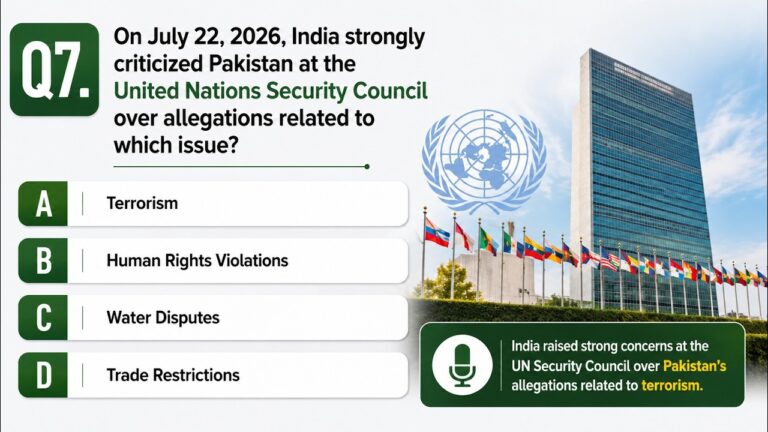
India Criticizes Pakistan at UNSC | July 2026 Current Affairs MCQ | International Relations
On July 22, 2026, India strongly criticized Pakistan at the

India Commonwealth Games 2026 Contingent | Glasgow 2026 | Sports Current Affairs MCQ
How many members are participating in the Indian contingent (including

India vs England T20I Series 2026 | Current Affairs MCQ | Sports Current Affairs July 2026
On 23 July 2026, India began a three-match T20I series