
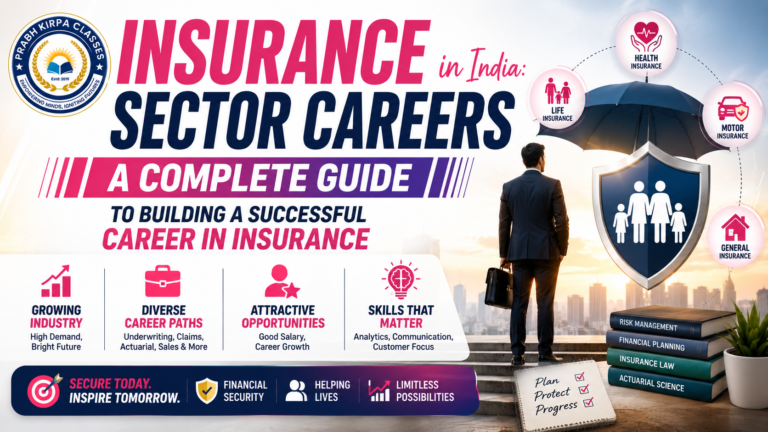
Insurance Sector Careers in India: A Complete Guide to Building a Successful Career in Insurance
The insurance sector has become an important part of India’s financial services industry. With increasing awareness about health, life, property, vehicles, businesses, and financial protection, the demand for insurance products and professionals continues to grow.
For students, graduates, freshers, and professionals looking for opportunities in the financial services sector, **insurance can offer a wide range of career paths**.
But what exactly does the insurance industry involve? What types of jobs are available? What skills do you need? And how can you prepare for a career in insurance?
Let’s explore everything you need to know.
## What Is Insurance?
Insurance is a financial arrangement designed to provide protection against specific risks.
An individual or organization pays a **premium** to an insurance company. In return, the insurer provides financial protection according to the terms and conditions of the insurance policy.
Depending on the type of insurance, coverage may include risks related to:
* Life
* Health
* Motor vehicles
* Property
* Travel
* Businesses
* Agriculture
* Liability
* Natural disasters
Insurance helps individuals and businesses manage financial uncertainty and unexpected losses.
—
# Why Is the Insurance Sector Important?
Insurance plays a major role in economic and financial stability.
When unexpected events occur, insurance can help policyholders manage financial losses. At the same time, the industry contributes to the broader financial system by mobilizing funds and supporting economic activity.
The insurance ecosystem includes:
* Insurance companies
* Policyholders
* Agents
* Brokers
* Corporate agents
* Third-party administrators
* Surveyors
* Underwriters
* Claims professionals
* Regulators
* Insurance intermediaries
This large ecosystem creates opportunities for professionals with different educational and skill backgrounds.
—
# Major Types of Insurance
Before building a career in insurance, it is important to understand the major categories.
## 1. Life Insurance
Life insurance provides financial protection linked to the life of the insured person.
Common products may include:
* Term Insurance
* Endowment Plans
* Whole Life Insurance
* Money-Back Plans
* ULIPs
* Pension and Annuity Products
Life insurance is often associated with long-term financial planning and protection.
—
## 2. Health Insurance
Health insurance helps cover eligible medical and healthcare-related expenses according to the policy terms.
Important concepts include:
* Sum Insured
* Premium
* Waiting Period
* Network Hospitals
* Cashless Treatment
* Claim
* Exclusions
* Deductibles
* Co-payment
Understanding these concepts is important for anyone preparing for an insurance-related examination or career.
—
## 3. Motor Insurance
Motor insurance provides coverage related to vehicles and specific risks covered by the policy.
Important concepts include:
* Third-Party Insurance
* Comprehensive Insurance
* Own Damage
* Premium
* IDV
* No Claim Bonus
* Add-On Covers
* Claims
Motor insurance is one of the important areas of general insurance.
—
## 4. General Insurance
General insurance covers risks other than life.
It may include:
* Health Insurance
* Motor Insurance
* Property Insurance
* Travel Insurance
* Marine Insurance
* Fire Insurance
* Liability Insurance
* Commercial Insurance
Professionals working in general insurance need to understand products, risk assessment, underwriting, claims, and policy terms.
—
# Career Opportunities in Insurance
One of the biggest advantages of the insurance sector is the variety of career opportunities.
Depending on your qualifications and interests, you can explore roles such as:
### Insurance Officer
Insurance officers may handle policy-related operations, customer requirements, documentation, claims, and other responsibilities depending on the organization and role.
### Underwriter
An underwriter evaluates risks and helps determine whether and under what conditions an insurance company should provide coverage.
Important areas include:
* Risk Assessment
* Policy Terms
* Customer Information
* Risk Classification
* Premium Considerations
### Claims Professional
Claims teams handle the process of evaluating and settling eligible claims according to policy terms.
They may review:
* Claim Forms
* Documents
* Policy Coverage
* Loss Details
* Investigation Reports
* Supporting Evidence
### Insurance Agent
Agents help customers understand insurance products and purchase policies suitable to their needs.
### Insurance Broker
Brokers can help customers compare and obtain insurance products from insurers, subject to the applicable regulatory framework.
### Actuarial Professional
Actuaries use mathematics, statistics, probability, and financial models to analyze risk and uncertainty.
This is a highly specialized career path requiring strong quantitative skills.
—
# Skills Required for an Insurance Career
A successful insurance professional needs more than theoretical knowledge.
Some important skills include:
### 1. Insurance Knowledge
You should understand fundamental concepts such as:
* Risk
* Premium
* Policy
* Insured
* Insurer
* Claim
* Coverage
* Exclusions
* Deductibles
* Sum Insured
### 2. Analytical Skills
Insurance involves evaluating information and assessing risk.
Strong analytical thinking can help professionals understand policies, customer information, claims, and business situations.
### 3. Communication Skills
Insurance professionals regularly communicate with customers, colleagues, intermediaries, and other stakeholders.
Clear communication is therefore extremely valuable.
### 4. Problem-Solving Skills
Insurance professionals may encounter complex policy, claims, and customer situations that require careful analysis and practical solutions.
### 5. Documentation Skills
Insurance involves significant documentation.
Professionals should be comfortable reviewing and maintaining accurate information.
—
# Insurance Exams and Competitive Careers
Insurance-related examinations are an important career route for many candidates interested in the financial services sector.
Depending on the recruitment organization and notification, candidates may encounter subjects such as:
* Reasoning
* Quantitative Aptitude
* English Language
* General Awareness
* Current Affairs
* Insurance Awareness
* Computer Knowledge
* Professional Knowledge
The exact syllabus, eligibility criteria, and selection process can vary by examination.
Therefore, candidates should always check the latest official recruitment notification before preparing for a specific examination.
—
# How to Prepare for Insurance Awareness
Insurance awareness is an important area for candidates preparing for insurance-related examinations.
Start with the basics.
### Step 1: Learn Insurance Terminology
Understand terms such as:
**Premium, Policyholder, Insured, Insurer, Claim, Nominee, Coverage, Exclusion, Deductible and Reinsurance.**
### Step 2: Understand Different Insurance Products
Study:
* Life Insurance
* Health Insurance
* Motor Insurance
* Fire Insurance
* Marine Insurance
* Travel Insurance
* Property Insurance
### Step 3: Understand the Insurance Market
Learn about:
* Insurance companies
* Insurance intermediaries
* Insurance distribution
* Regulatory framework
* Reinsurance
* Digital insurance
### Step 4: Follow Current Affairs
Insurance-related current affairs can include:
* Regulatory developments
* New insurance products
* Industry initiatives
* Mergers and acquisitions
* Government schemes
* Financial inclusion
* Digital insurance developments
### Step 5: Practice MCQs
Regular MCQ practice helps you revise concepts and improve your ability to answer questions under exam conditions.
—
# What Is Reinsurance?
Reinsurance is an important concept in the insurance industry.
In simple terms, **reinsurance is insurance for insurance companies**.
An insurer may transfer part of its risk to another insurance company, known as a reinsurer.
This helps insurers manage exposure to large or unexpected losses and supports their ability to underwrite risks.
Understanding reinsurance is important for candidates preparing for advanced insurance awareness topics.
—
# Insurance and Technology
Technology is transforming the insurance industry.
Insurance companies increasingly use technology for:
* Online Policy Issuance
* Digital Payments
* Customer Service
* Claims Processing
* Data Analytics
* Fraud Detection
* Risk Assessment
* Artificial Intelligence
* Automation
The growth of **InsurTech** is also creating new opportunities for professionals who understand both insurance and technology.
This means future insurance professionals may benefit from developing digital and analytical skills alongside insurance knowledge.
—
# How to Build a Career in Insurance
If you are starting from scratch, follow a structured approach.
### Build Your Foundation
Understand insurance fundamentals and financial terminology.
### Study the Industry
Learn about life insurance, general insurance, health insurance, reinsurance, distribution channels, and claims.
### Improve General Awareness
Stay updated with financial and economic developments.
### Practice Regularly
Solve insurance awareness questions and mock tests regularly.
### Improve Communication
Develop professional English and communication skills because many insurance roles involve customer interaction and documentation.
### Follow Official Updates
For competitive examinations and regulatory developments, rely on official notifications and authoritative sources.
—
# Why Choose Insurance as a Career?
Insurance offers several potential advantages:
* Multiple career paths
* Opportunities across financial services
* Roles for different educational backgrounds
* Scope for specialization
* Opportunities in both public and private sectors
* Growing use of technology
* Opportunities to develop financial and analytical expertise
However, candidates should choose a role based on their interests, qualifications, strengths, and long-term career goals.
—
# Final Thoughts
The insurance sector is much broader than simply selling insurance policies.
It includes **underwriting, claims, risk management, actuarial science, customer service, operations, sales, compliance, technology, analytics, and financial services**.
For candidates preparing for insurance examinations or exploring insurance as a career, the key is to develop a strong understanding of fundamentals and continuously stay updated with industry developments.
A structured preparation strategy can make the learning process easier:
**Learn Concepts → Understand the Industry → Follow Current Affairs → Practice MCQs → Revise Regularly → Prepare for the Exam**
With consistent preparation and the right learning resources, insurance can become a valuable career path within India’s financial services ecosystem.
## Frequently Asked Questions
### Is insurance a good career option?
Insurance offers diverse career opportunities across underwriting, claims, sales, operations, risk management, actuarial science, technology, and other areas.
### What should I study for insurance exams?
Depending on the examination, preparation may include reasoning, quantitative aptitude, English, current affairs, general awareness, insurance awareness, computer knowledge, and professional knowledge.
### What is the difference between life and general insurance?
Life insurance primarily provides coverage related to human life and long-term financial protection, while general insurance covers various non-life risks such as vehicles, health, property, travel, and businesses.
### What is reinsurance?
Reinsurance is an arrangement in which an insurer transfers part of its risk to another insurer or reinsurer.
### How can I improve my insurance awareness?
Study fundamental insurance concepts, understand different insurance products, follow current industry developments, and regularly practice insurance-related MCQs.
### What skills are useful for insurance jobs?
Insurance knowledge, communication, analytical thinking, problem-solving, documentation, customer handling, and digital skills can all be valuable depending on the role.
Newsletter
Recent Posts
What Major Constitutional Change Did Guinea-Bissau Vote on in the August 30, 2026 Referendum?
What major constitutional change did Guinea-Bissau vote on in the

Who Did Donald Trump Send on a Highly Confidential Diplomatic Mission to Moscow?
Who was reportedly sent by U.S. President Donald Trump on
Insurance Sector Careers in India: A Complete Guide to Building a Successful Career in Insurance
The insurance sector has become an important part of India’s
Apex vs LWC: What Should You Learn as a Salesforce Developer?
Salesforce development is no longer limited to writing server-side code.