
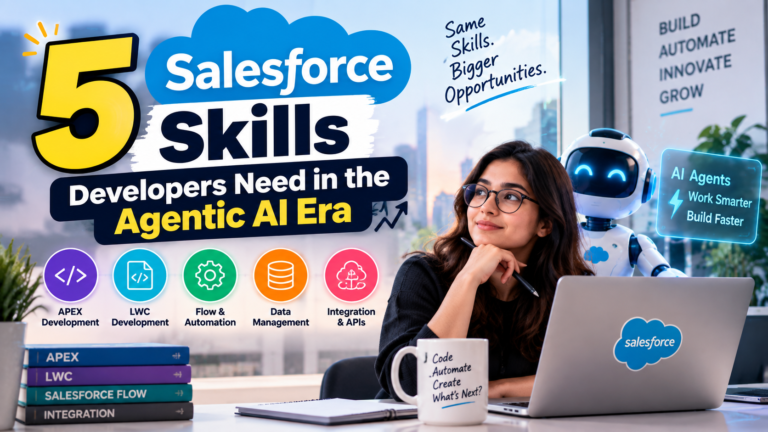
“5 Salesforce Skills Developers Need in the Agentic AI Era”
The Salesforce ecosystem is entering a major transformation.
For years, Salesforce developers primarily focused on technologies such as Apex, Lightning Web Components (LWC), SOQL, APIs, Salesforce Flow, integrations, and custom applications. These skills remain important, but the rise of generative AI and agentic AI is changing what companies expect from Salesforce professionals.
AI is moving beyond simply generating text or answering questions. Modern AI agents can understand a goal, reason over business context, interact with enterprise data, and perform actions through connected systems.
Salesforce’s Agentforce is designed around this shift, enabling organizations to build and deploy AI agents that can work across business processes.
For Salesforce developers, this creates a new opportunity.
The developers who understand how to combine Salesforce development + automation + data + AI agents + integrations can become valuable contributors to the next generation of CRM applications.
So, what skills should Salesforce developers focus on?
Here are 5 Salesforce skills developers need in the Agentic AI era.
1. Agentforce and AI Agent Development
The first skill developers should understand is Agentforce.
Traditional Salesforce development generally works like this:
User → Salesforce UI → Apex/Flow → Database → Result
Agentic applications introduce another layer:
User → AI Agent → Reasoning/Instructions → Salesforce Data → Actions → Result
The AI agent can interpret what the user wants and determine which available actions should be used.
For example, imagine a customer saying:
“My order hasn’t arrived. Please check the status and tell me what I should do.”
A traditional application may require the user to navigate through several screens.
An AI agent could potentially:
- Understand the request.
- Identify the customer’s record.
- Retrieve the order.
- Check its status.
- Identify relevant business rules.
- Provide an explanation.
- Take an approved action if required.
For developers, this means learning how agents interact with Salesforce.
What Developers Should Learn
Salesforce developers should become familiar with concepts such as:
- Agentforce
- AI agents
- Agent instructions
- Topics and actions
- Agent actions
- Grounding
- Agent orchestration
- AI-generated responses
- Agent testing
- Guardrails
- Human escalation
The important point is that developers don’t simply need to learn how to “use AI.”
They need to understand how AI agents interact with enterprise applications.
Why Agentforce Knowledge Matters
AI agents need access to business capabilities.
A developer might create an Apex-based action that allows an agent to perform a specific operation.
For example:
Agent: “Find all open opportunities for this customer.”
Action: Execute an approved Salesforce operation.
Result: Return relevant opportunity information.
The developer’s responsibility is to make sure the action is properly designed, secure, predictable, and appropriate for the agent to use.
This makes Agentforce knowledge increasingly relevant for Salesforce developers working on AI-enabled CRM solutions.
2. Apex + Salesforce Automation
AI does not replace traditional Salesforce development.
In many cases, it makes traditional development more important.
Why?
Because agents need reliable actions.
If an AI agent needs to update a Salesforce record, trigger a business process, calculate a value, or communicate with another system, developers may need to create the underlying functionality.
That’s where Apex continues to matter.
Developers should maintain strong knowledge of:
- Apex classes
- Triggers
- SOQL
- DML
- Exception handling
- Asynchronous Apex
- Governor limits
- Test classes
- Integration patterns
- Security controls
However, the mindset is changing.
Instead of asking:
“How do I build this feature?”
Developers increasingly need to ask:
“How can I expose this capability safely to an automated or AI-driven workflow?”
Example: Apex + AI Agent
Suppose a company wants an AI service agent to check whether a replacement component is available.
The architecture could look like:
Customer Request
↓
Agentforce
↓
Agent Action
↓
Apex Service
↓
Inventory System
↓
Result
↓
Agent Response
The Apex layer may handle authentication, business rules, data transformation, error handling, and integration.
The AI agent handles the conversational layer and determines when the action is relevant.
This creates a partnership between AI reasoning and deterministic software logic.
That distinction is important.
AI can interpret a user’s intent, but critical business operations should still be governed by controlled application logic.
3. Data Cloud and AI-Ready Data
One of the biggest lessons of the AI era is simple:
AI is only as useful as the information it can reliably access.
Salesforce developers therefore need stronger data skills.
AI agents require context.
A customer might have information spread across:
- Salesforce CRM
- Data warehouses
- ERP systems
- Marketing platforms
- Customer portals
- Service applications
- External APIs
If these systems remain disconnected, an AI agent may not have the complete context required to answer a question accurately.
This is where Salesforce Data Cloud, now increasingly referred to as Data 360, becomes important in Salesforce’s data and AI architecture.
Developers should understand concepts such as:
- Data ingestion
- Data modeling
- Data integration
- Identity resolution
- Unified customer profiles
- Data mapping
- Data grounding
- Data security
- Real-time data access
Why Data Grounding Matters
Imagine a customer asks:
“Which Salesforce products are we currently using?”
An AI system shouldn’t simply generate an answer based on general knowledge.
It needs access to the organization’s actual data.
The workflow could be:
Customer Question
↓
AI Agent
↓
Trusted Enterprise Data
↓
Relevant Customer Context
↓
AI Response
This process is often described through concepts such as grounding, where AI responses are connected to relevant enterprise information.
For developers, understanding how Salesforce data becomes available to AI systems is therefore becoming an important skill.
4. APIs and Integration Architecture
Modern enterprises rarely use Salesforce alone.
Salesforce applications commonly communicate with:
- ERP systems
- Payment platforms
- Marketing tools
- Data warehouses
- E-commerce platforms
- HR systems
- Customer portals
- External databases
- AI services
In the agentic AI era, integrations become even more important.
Why?
Because an AI agent may need to take action across multiple systems.
Imagine a customer asks:
“Can you check my order and change the delivery address?”
The information may exist in Salesforce, but the actual order might be managed by an external ERP or commerce system.
The architecture could look like:
Customer
↓
Agentforce
↓
Salesforce
↓
API / Integration Layer
↓
External System
↓
Response
Developers who understand APIs can help connect these systems.
APIs Salesforce Developers Should Understand
Developers should have a strong foundation in:
- REST APIs
- SOAP APIs
- OAuth
- JSON
- HTTP methods
- Authentication
- Named Credentials
- External Credentials
- Webhooks
- Platform Events
- Event-driven architecture
- Integration error handling
They should also understand when to use synchronous versus asynchronous communication.
5. AI Security, Governance, and Responsible Development
Perhaps the most important skill in the agentic AI era is security.
Giving an AI agent the ability to read information is one thing.
Giving it the ability to take action is another.
An AI agent might potentially:
- Create records
- Update records
- Send messages
- Retrieve customer information
- Start workflows
- Call APIs
- Trigger business processes
That creates new security considerations.
Salesforce developers need to understand how to ensure AI agents operate within appropriate boundaries.
Important Security Concepts
Developers should pay attention to:
Permission Sets
Agents should have only the permissions they actually need.
Object-Level Security
Developers must consider which objects an agent can access.
Field-Level Security
Sensitive fields should not automatically become available simply because an agent can access a record.
Sharing Rules
Record-level access remains important.
Authentication
External integrations need secure authentication mechanisms.
Auditability
Organizations need visibility into what automated systems are doing.
Human Escalation
High-risk or ambiguous actions may require human approval.
Agentic AI Changes the Salesforce Developer Role
The traditional Salesforce developer role is evolving.
Earlier, a developer might have primarily focused on:
Apex + LWC + SOQL + Integrations
Today, the skill stack can increasingly look like:
Apex + LWC + Flow + APIs + Data + Agentforce + AI Governance
The developer becomes more than a coder.
They become a solution architect for AI-enabled business processes.
Traditional Automation vs Agentic Automation
It helps to understand the difference.
| Traditional Automation | Agentic Automation |
|---|---|
| Rule-based | Goal-oriented |
| Predetermined workflow | Can determine appropriate actions |
| Structured inputs | Can interpret natural language |
| Fixed process | More flexible process |
| Human initiates many tasks | Agent can initiate approved actions |
| Primarily deterministic | Combines AI with deterministic systems |
However, agentic automation does not mean that every process should become autonomous.
For critical business processes, developers may still prefer deterministic workflows and explicit approvals.
The strongest architecture can combine both approaches.
The Future: Developers + AI Agents
The future Salesforce environment may involve humans working alongside multiple specialized agents.
For example:
Sales Agent
Handles lead engagement and qualification.
Service Agent
Handles customer support and service requests.
Data Agent
Retrieves relevant enterprise information.
Engineering Agent
Provides access to technical product information.
Human Employee
Handles complex decisions and exceptions.
These agents may interact with Salesforce, external applications, APIs, and enterprise data.
Salesforce’s Agentforce vision is moving toward this type of agent-based business architecture.
For developers, this creates a new design challenge:
How should different agents, workflows, APIs, and humans work together?
How Salesforce Developers Can Prepare
If you’re a Salesforce developer preparing for the Agentic AI era, don’t try to learn everything at once.
A practical roadmap can look like this:
Step 1: Strengthen Salesforce Fundamentals
Learn:
- Objects
- Relationships
- SOQL
- DML
- Apex
- Triggers
- Flow
- Security
Step 2: Improve Integration Skills
Learn:
- REST APIs
- JSON
- OAuth
- Named Credentials
- Platform Events
Step 3: Learn Salesforce Data Architecture
Explore:
- Data Cloud/Data 360
- Data modeling
- Data integration
- Data grounding
Step 4: Learn Agentforce
Understand:
- Agents
- Topics
- Instructions
- Actions
- Agent workflows
- Testing
- Guardrails
Step 5: Build AI-Enabled Projects
Don’t stop at tutorials.
Build projects.
For example:
Project 1: AI Lead Qualification Agent
Project 2: AI Customer Service Agent
Project 3: AI Opportunity Assistant
Project 4: AI Case Summary Agent
Project 5: AI Product Recommendation Workflow
Projects help demonstrate that you can connect Salesforce development skills with AI capabilities.
Why These Skills Can Matter for Careers
Companies adopting AI don’t necessarily need fewer technical professionals.
They need professionals who can help them implement AI safely and effectively.
For Salesforce developers, this can create opportunities across roles such as:
- Salesforce Developer
- Salesforce AI Developer
- Salesforce Technical Consultant
- Salesforce Solution Architect
- Agentforce Specialist
- Salesforce Integration Developer
- Salesforce Data Specialist
- CRM AI Consultant
The exact requirements vary by organization, but the overall direction is clear: Salesforce development is becoming increasingly connected with AI, automation, data, and integration architecture.
Final Thoughts
The Agentic AI era doesn’t mean Salesforce developers need to abandon the skills they’ve already built.
Instead, they need to extend them.
Apex provides reliable business logic.
Flow provides automation.
APIs connect systems.
Data 360 can provide unified business context.
Agentforce adds an intelligent interaction and orchestration layer.
Security and governance keep the system controlled.
Together, these capabilities can create powerful AI-enabled Salesforce solutions.
The Salesforce developer of the future may not simply build applications that users interact with manually.
They may build applications where humans, AI agents, automation, enterprise data, and external systems work together.
Newsletter
Recent Posts
“5 Salesforce Skills Developers Need in the Agentic AI Era”
The Salesforce ecosystem is entering a major transformation. For years,
Salesforce Agentforce + Siemens: The Future of Industrial Automation?
The industrial world is entering a new phase of digital

Article 371(K) for Ladakh | New Constitutional Safeguard | Current Affairs 2026
The Union Government has proposed inserting a new Article 371(K)

New Delhi Leaders’ Declaration | G20 Summit 2023 | Climate Change & Sustainable Development
The G20 New Delhi Leaders’ Declaration was adopted at the