
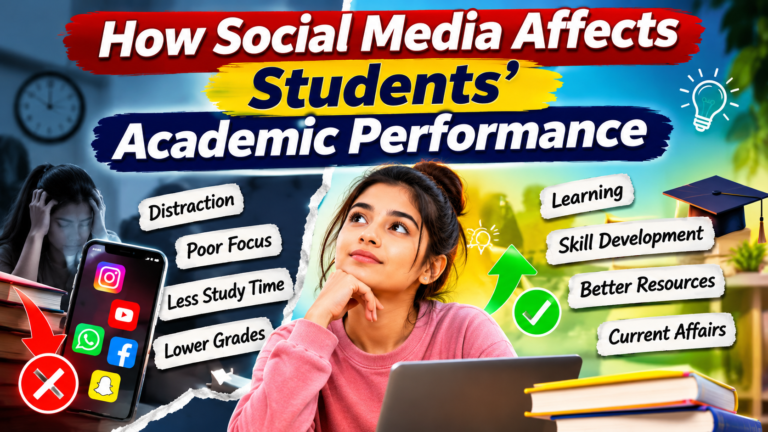
How Social Media Affects Students’ Academic Performance
In today’s digital world, social media has become an essential part of students’ daily lives. Platforms such as Instagram, YouTube, Facebook, Snapchat, and WhatsApp have transformed the way students communicate, learn, share information, and spend their free time.
While social media offers numerous educational opportunities, excessive and uncontrolled usage can negatively affect academic performance, concentration, mental health, and productivity.
The impact of social media on students largely depends on how they use it. When used responsibly, it can become a powerful educational tool. However, when it becomes a constant distraction, it can create significant challenges in a student’s academic journey.
At Prabh Kirpa Classes, we believe that maintaining a healthy balance between technology and education is essential for academic success and personal development.
Understanding the Role of Social Media in Students’ Lives
Social media is no longer limited to entertainment and communication. It has become a platform for education, career development, networking, creativity, and knowledge sharing.
Students use social media for various purposes, including:
- Watching educational videos and tutorials
- Preparing for competitive examinations
- Learning new languages and professional skills
- Communicating with teachers and classmates
- Accessing current affairs and general knowledge
- Participating in online study groups
- Sharing educational resources
- Entertainment and relaxation
Although these activities can support learning, students must understand the difference between productive and unproductive social media usage.
Positive Effects of Social Media on Academic Performance
1. Easy Access to Educational Resources
One of the biggest advantages of social media is the availability of educational content.
Students can access online lectures, study materials, practice questions, educational videos, and subject-related explanations from almost anywhere.
Platforms such as YouTube and educational social media pages help students understand difficult concepts through visual explanations and practical examples.
This makes learning more accessible, flexible, and engaging.
2. Improved Communication and Collaboration
Social media allows students to communicate with teachers and classmates beyond traditional classroom hours.
Through online communities and study groups, students can:
- Discuss difficult topics
- Share notes and assignments
- Ask questions
- Exchange study materials
- Prepare for examinations together
Collaborative learning can improve understanding and encourage students to actively participate in academic discussions.
3. Development of New Skills
Social media provides opportunities to develop valuable academic and professional skills.
Students can learn:
- English communication
- Public speaking
- Digital marketing
- Computer programming
- Graphic designing
- Creative writing
- Leadership and communication
- Time management
These skills can contribute to both academic improvement and future career opportunities.
4. Increased Awareness of Current Affairs
Social media helps students stay informed about national and international developments.
Students preparing for competitive examinations can benefit from reliable educational pages that provide daily current affairs, general knowledge, government schemes, and important national and international updates.
Regular exposure to accurate information can strengthen general awareness and examination preparation.
However, students should always verify information before accepting it as factual.
5. Encourages Creativity and Innovation
Social media gives students a platform to express their ideas, showcase their talents, and explore creative opportunities.
Creating educational videos, presentations, blogs, digital artwork, and informative content can improve critical thinking, communication, and creativity.
These activities encourage students to become active creators rather than passive consumers of digital content.
6. Flexible and Personalized Learning
Every student has a different learning speed and preferred learning style.
Social media allows students to explore educational content according to their individual needs. They can pause videos, revisit explanations, and learn at their own pace.
This flexibility can be particularly helpful for students who need additional time to understand complex academic concepts.
Negative Effects of Social Media on Academic Performance
1. Reduced Concentration and Focus
One of the most common disadvantages of excessive social media usage is reduced concentration.
Constant notifications, messages, reels, and short videos can interrupt study sessions and make it difficult for students to focus on academic tasks.
Frequently switching between studying and checking social media can make learning less efficient.
Students may spend several hours sitting with their books without completing meaningful academic work.
2. Poor Time Management
Social media platforms are designed to keep users engaged. Students often open an application for a few minutes but end up spending much more time scrolling through content.
Excessive social media usage can lead to:
- Incomplete assignments
- Delayed homework
- Reduced revision time
- Missed academic deadlines
- Poor examination preparation
- Increased procrastination
Effective time management is essential for academic success, and uncontrolled social media usage can become a major obstacle.
3. Disturbed Sleep Patterns
Many students use smartphones and social media late at night.
Late-night scrolling can delay bedtime and reduce the amount of sleep students receive. Engaging content and screen exposure close to bedtime may also make it harder to relax.
Insufficient sleep can affect memory, attention, emotional regulation, and learning ability.
Students who do not get adequate sleep may experience tiredness during classes and difficulty remembering important information.
4. Increased Stress and Anxiety
Social media often presents carefully selected highlights of people’s lives.
Students may compare their academic achievements, appearance, lifestyle, and personal progress with others.
Constant comparison can contribute to feelings of insecurity, stress, anxiety, and low self-confidence.
Fear of missing out, commonly known as FOMO, may also encourage students to check their social media accounts repeatedly.
These emotional distractions can negatively influence academic motivation and performance.
5. Increased Procrastination
Procrastination occurs when students delay important tasks in favour of more enjoyable activities.
Instead of completing homework or preparing for examinations, students may spend time watching reels, chatting with friends, or browsing entertaining content.
Although these activities provide temporary enjoyment, they can create unnecessary academic pressure when deadlines approach.
Developing self-discipline is essential for overcoming this habit.
6. Reduced Face-to-Face Communication
Excessive dependence on online communication may reduce opportunities for meaningful face-to-face interaction.
Students need real-world communication skills to participate confidently in classroom discussions, interviews, presentations, and group activities.
Maintaining a balance between digital communication and personal interaction can support social and academic development.
7. Exposure to Misinformation
Not every piece of information available on social media is accurate.
Students may encounter misleading educational content, incorrect facts, outdated information, and unverified news.
Depending entirely on social media for academic preparation without checking reliable sources can result in misunderstandings and incorrect learning.
Students should verify information through textbooks, official websites, qualified educators, and trusted educational resources.
How Social Media Affects Memory and Learning
Effective learning requires attention, understanding, repetition, and memory retention.
When students frequently check their phones while studying, their attention becomes divided. This can interfere with their ability to process and remember information.
Short-form content also encourages rapid consumption of information. For some students, a habit of constantly switching between short videos may make sustained reading and focused study feel more difficult.
To improve learning efficiency, students should create distraction-free study environments and avoid unnecessary digital interruptions.
Social Media Addiction Among Students
Some students develop problematic patterns of social media usage that become difficult to control.
Common warning signs include:
- Checking social media immediately after waking up
- Feeling restless when unable to access a smartphone
- Using social media during study hours
- Frequently delaying academic responsibilities
- Spending excessive time scrolling
- Staying awake late at night to use social media
- Finding it difficult to reduce screen time
These behaviours do not automatically indicate a clinical addiction, but they may suggest that a student’s digital habits need attention.
Recognizing unhealthy patterns early can help students develop better routines and regain control over their time.
Educational vs Recreational Social Media Usage
The purpose behind social media usage plays an important role in determining its academic impact.
| Educational Usage | Excessive Recreational Usage |
|---|---|
| Watching educational tutorials | Endless scrolling |
| Participating in study groups | Constant unnecessary chatting |
| Learning professional skills | Excessive entertainment |
| Reading verified current affairs | Consuming misleading information |
| Practising English communication | Repeatedly checking notifications |
| Accessing study materials | Delaying academic responsibilities |
Entertainment is not necessarily harmful. Students need relaxation and recreation, but these activities should not interfere with essential academic responsibilities.
How Students Can Use Social Media Responsibly
1. Set Daily Screen Time Limits
Students should establish reasonable limits for recreational social media usage.
Screen time management features available on smartphones can help students understand their digital habits and reduce unnecessary usage.
The appropriate limit depends on age, academic responsibilities, and individual needs.
2. Create a Study Schedule
A structured study timetable helps students organize their academic responsibilities effectively.
Students should allocate dedicated time for studying, revision, physical activities, relaxation, and social media.
Following a consistent schedule can improve productivity and reduce procrastination.
3. Turn Off Unnecessary Notifications
Notifications are a major source of distraction during study sessions.
Students should disable unnecessary notifications or activate focus mode while studying.
Keeping smartphones away from the study desk can also help maintain concentration.
4. Follow Educational and Motivational Pages
Instead of filling their social media feeds entirely with entertainment, students should follow pages that provide meaningful educational content.
Useful topics include English grammar, vocabulary, current affairs, competitive examination preparation, career guidance, and personal development.
A carefully selected social media feed can make digital time more productive.
5. Follow the Pomodoro Technique
The Pomodoro Technique is a popular time management method that encourages focused learning.
Students can study for 25 minutes, take a five-minute break, and repeat the process. After four sessions, they can take a longer break.
This technique can help students maintain concentration and complete academic tasks without feeling overwhelmed.
6. Avoid Social Media Before Bedtime
Students should consider avoiding social media for at least 30 to 60 minutes before sleeping.
Reading, meditation, planning the next day, or light stretching can be healthier alternatives.
Maintaining a consistent sleep schedule supports academic performance and overall well-being.
7. Set Clear Academic Goals
Students with clear academic goals are more likely to recognize activities that support or interfere with their progress.
Setting daily, weekly, and monthly study targets can encourage discipline and motivation.
Before opening a social media application, students can ask themselves whether the activity will help them achieve their goals or simply consume their time.
Role of Parents in Managing Students’ Social Media Usage
Parents play an important role in helping children develop responsible digital habits.
Rather than completely restricting technology, parents should encourage balanced and meaningful usage.
Parents can establish healthy screen time routines, encourage outdoor activities, discuss online safety, and maintain open communication about academic challenges.
They should also demonstrate responsible technology usage through their own behaviour.
A supportive environment can help students develop self-discipline without creating unnecessary conflict.
Role of Teachers and Educational Institutions
Teachers can guide students toward productive and responsible social media usage.
Educational institutions can organize digital literacy workshops, promote reliable learning resources, and encourage students to use technology for academic development.
Teachers can also incorporate educational videos, interactive quizzes, online discussions, and digital assignments into their teaching methods.
When technology is integrated thoughtfully into education, it can improve student engagement and create additional learning opportunities.
Does Social Media Always Lead to Poor Academic Performance?
No. Social media does not automatically lead to poor academic performance.
Its effects depend on several factors, including the amount of time spent online, the type of content consumed, the student’s self-discipline, sleep habits, and academic responsibilities.
A student who uses social media for educational purposes while maintaining a healthy routine may benefit from digital learning opportunities.
However, a student who spends excessive time consuming entertainment at the expense of studying may experience academic difficulties.
It is also important to understand that academic performance is influenced by many factors. Social media usage alone does not determine a student’s success or failure.
Building a Healthy Balance Between Social Media and Education
Students do not necessarily need to stop using social media completely. Instead, they should learn to control their digital habits.
A balanced daily routine may include focused study sessions, regular revision, physical exercise, sufficient sleep, family interaction, and limited recreational screen time.
Students should treat social media as a tool for learning and communication rather than allowing it to control their daily routines.
Small improvements, such as reducing unnecessary scrolling or keeping smartphones away during study sessions, can gradually improve academic productivity.
Frequently Asked Questions
1. Is social media good or bad for students?
Social media can be both beneficial and harmful. Educational and responsible usage can support learning, while excessive recreational usage can negatively affect concentration and academic productivity.
2. How does social media affect students’ grades?
Excessive usage may reduce study time, disturb sleep, increase procrastination, and interrupt concentration. These factors can contribute to lower academic performance.
3. Can social media improve academic performance?
Yes. Educational videos, online study groups, current affairs updates, and skill-development content can support academic learning when used appropriately.
4. How can students avoid social media distractions?
Students can disable notifications, set screen time limits, use focus mode, create study schedules, and keep their phones away during important academic tasks.
5. Should students completely stop using social media?
Not necessarily. Responsible usage and effective time management are generally more practical than completely avoiding social media.
6. Does social media affect students’ mental health?
Excessive usage, online comparison, cyberbullying, and fear of missing out can contribute to stress and emotional difficulties. However, positive online communities can also provide social support.
7. What is the best way to use social media for education?
Students should follow trusted educational pages, watch relevant tutorials, participate in productive study groups, practise academic skills, and verify information before relying on it.
Conclusion
Social media has become an important part of modern education and student life. It offers countless opportunities for learning, communication, creativity, and professional development. However, excessive and uncontrolled usage can negatively affect concentration, time management, sleep, mental health, and academic performance.
The key to success lies in maintaining a healthy balance between digital engagement and academic responsibilities.
Students must develop self-discipline, set clear priorities, and use technology as a resource for growth rather than a source of distraction.
At Prabh Kirpa Classes, we encourage students to develop effective study habits, strengthen their knowledge, improve their skills, and make responsible use of digital learning opportunities.
Remember, social media should support
Newsletter
Recent Posts
How Social Media Affects Students’ Academic Performance
In today’s digital world, social media has become an essential
India’s Free Tourist E-Visa Proposal | Current Affairs 2026
Can you identify the regional grouping mentioned in India’s free
Manila Summit & Indo-Pacific | Current Affairs 2026
Can you identify the international grouping mentioned in this Manila

Commercial Tanker Attacks | Maritime Current Affairs 2026
Can you identify the strategic maritime chokepoint mentioned in this