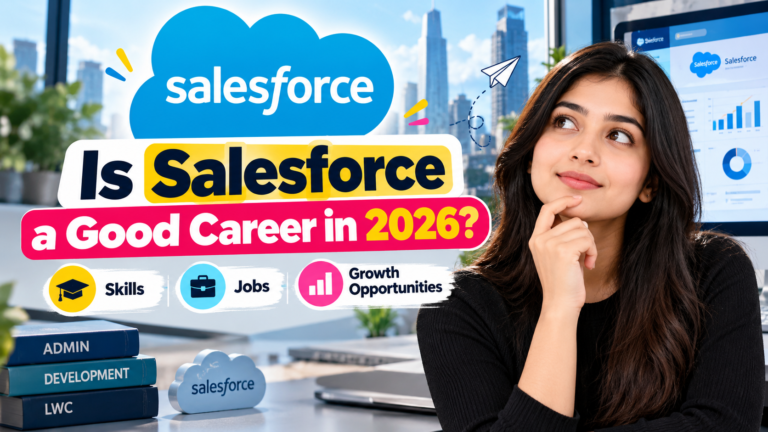
Is Salesforce a Good Career in 2026? Skills, Jobs & Growth Opportunities
Choosing the right technology career can be challenging, especially when the industry is changing rapidly with artificial intelligence, automation, cloud computing, and new digital technologies.
One platform that continues to attract professionals and businesses is Salesforce. From customer relationship management (CRM) and sales automation to artificial intelligence, data management, analytics, and application development, Salesforce has expanded far beyond traditional CRM.
But an important question remains:
Is Salesforce a good career in 2026?
For students, freshers, working professionals, and people planning a career switch, Salesforce can offer several career paths. However, success depends on developing the right skills, understanding the Salesforce ecosystem, gaining practical experience, and continuously adapting to new technologies such as AI and Agentforce.
In this guide, we will explore Salesforce career opportunities in 2026, popular job roles, essential skills, certifications, salary factors, career growth, and a practical roadmap for becoming job-ready.
What Is Salesforce?
Salesforce is a cloud-based customer relationship management platform used by organizations to manage sales, customer service, marketing, data, automation, and other business processes.
The Salesforce ecosystem includes multiple products and technologies, including:
- Sales Cloud
- Service Cloud
- Marketing Cloud
- Experience Cloud
- Data Cloud
- Tableau
- MuleSoft
- Slack
- Platform
- Agentforce
- Lightning Web Components
- Apex
- Salesforce Flow
Because Salesforce supports both business users and technical professionals, it offers career opportunities for people with different backgrounds.
Is Salesforce a Good Career in 2026?
Yes, Salesforce remains a significant technology career option in 2026, particularly for professionals who combine Salesforce expertise with business understanding, automation, data, development, and AI skills.
However, the Salesforce job market is not simply about learning a few clicks and getting a job.
The ecosystem is becoming more advanced.
Earlier, professionals could focus primarily on Salesforce administration or basic configuration. Today, employers increasingly value professionals who can work with automation, integrations, development, analytics, data, security, and AI-powered Salesforce capabilities.
This means the opportunity is evolving.
Instead of asking only:
“Should I learn Salesforce?”
A better question is:
“Which Salesforce skills should I learn to build a long-term career?”
Why Salesforce Continues to Be Important
1. Salesforce Is More Than a CRM
Salesforce started primarily as a CRM platform, but its ecosystem now covers a much broader range of business requirements.
Companies can use Salesforce for:
- Sales management
- Customer service
- Marketing
- Workflow automation
- Data management
- Analytics
- Application development
- Customer portals
- Integrations
- AI-powered experiences
This creates different career paths rather than a single Salesforce job profile.
2. Cloud Technology Remains Important
Organizations continue to use cloud platforms to manage business applications and customer data.
Salesforce professionals therefore work at the intersection of:
Business + Cloud + Data + Automation + Technology
This combination makes Salesforce knowledge useful across many industries.
3. AI Is Changing Salesforce Careers
Artificial intelligence is becoming an increasingly important part of the Salesforce ecosystem.
Salesforce’s AI capabilities, including Agentforce, are changing how organizations think about customer interactions, automation, and AI agents.
For professionals, this means AI should not necessarily be viewed only as competition.
It can also become a new skill area.
A Salesforce professional who understands both CRM processes and AI-enabled automation can potentially work on more advanced projects.
Top Salesforce Career Opportunities in 2026
One of the biggest advantages of Salesforce is the number of different roles available within its ecosystem.
1. Salesforce Administrator
Salesforce Administrators help organizations configure and manage Salesforce according to business requirements.
Typical responsibilities include:
- User management
- Security and permissions
- Reports and dashboards
- Workflow configuration
- Salesforce Flow
- Data management
- Custom objects and fields
- Business process configuration
This can be a suitable starting point for people who want to enter Salesforce without becoming full-time programmers immediately.
2. Salesforce Developer
Salesforce Developers work on the technical side of the platform.
Common technologies include:
- Apex
- Lightning Web Components (LWC)
- SOQL
- SOSL
- APIs
- Salesforce Flow
- Salesforce integrations
Developers may build custom applications and functionality that cannot be achieved through standard configuration alone.
3. Salesforce Consultant
Salesforce Consultants help organizations understand business requirements and implement Salesforce solutions.
They may work with:
- Business stakeholders
- Administrators
- Developers
- Project managers
- Salesforce architects
Consulting requires both technical knowledge and strong communication skills.
4. Salesforce Business Analyst
Salesforce Business Analysts focus on understanding business problems and translating them into Salesforce requirements.
Important skills include:
- Requirement gathering
- Process mapping
- Documentation
- User stories
- Stakeholder communication
- Salesforce fundamentals
This role can be attractive for professionals with business or analytical backgrounds.
5. Salesforce Architect
Salesforce Architects work on complex technical and business solutions.
They may be responsible for:
- Solution architecture
- Data architecture
- Integration architecture
- Security
- Scalability
- Technical design
Architecture is generally a more advanced career stage and requires substantial experience.
6. Salesforce Marketing Cloud Professional
Marketing Cloud professionals work on digital marketing and customer engagement solutions.
Relevant areas include:
- Email marketing
- Customer journeys
- Automation
- Personalization
- Data
- Campaign management
7. Salesforce Data and AI Professional
As Salesforce becomes increasingly focused on data and AI, professionals can explore areas such as:
- Data Cloud
- AI
- Agentforce
- Analytics
- Automation
- Customer data
- AI-assisted workflows
These areas can complement traditional Salesforce skills.
Salesforce Skills to Learn in 2026
If you are planning to build a Salesforce career, don’t try to learn everything at once.
Start with fundamentals and gradually move toward specialized skills.
Salesforce Fundamentals
First understand:
- CRM concepts
- Salesforce navigation
- Objects
- Fields
- Records
- Relationships
- Profiles
- Permission Sets
- Roles
- Reports
- Dashboards
These concepts create the foundation for advanced learning.
Salesforce Flow
Flow is an important automation technology within Salesforce.
You should understand:
- Record-triggered flows
- Screen flows
- Scheduled flows
- Variables
- Decisions
- Loops
- Get Records
- Create Records
- Update Records
- Delete Records
Automation knowledge can be valuable for both administrators and developers.
Apex
If you want to become a Salesforce Developer, Apex is an important programming language to learn.
You should understand:
- Variables
- Data types
- Collections
- Classes
- Methods
- SOQL
- DML
- Exception handling
- Triggers
- Test classes
Lightning Web Components
LWC is used to create modern user interfaces on Salesforce.
Important concepts include:
- Components
- HTML
- JavaScript
- CSS
- Properties
- Events
- Data binding
- Apex integration
APIs and Integration
Modern businesses rarely use Salesforce completely in isolation.
Salesforce may need to communicate with:
- ERP systems
- Payment systems
- Websites
- Mobile applications
- Data platforms
- External databases
Therefore, learning REST APIs, SOAP APIs, authentication, and integration concepts can be valuable.
AI and Agentforce
AI is becoming an increasingly relevant skill area.
Professionals should understand basic concepts around:
- Generative AI
- AI agents
- Prompting
- Automation
- Data grounding
- AI governance
- Agentforce
- Customer service AI use cases
You don’t necessarily need to become an AI researcher.
Instead, learn how AI can solve real business problems within the Salesforce ecosystem.
Salesforce Certifications in 2026
Salesforce certifications can help demonstrate knowledge and provide a structured learning path.
Depending on your career goal, you may explore certifications related to:
- Salesforce Administrator
- Platform Developer
- Platform App Builder
- Business Analyst
- Sales Cloud
- Service Cloud
- Marketing Cloud
- Advanced Administrator
- Data Cloud
- AI-related Salesforce credentials
However, certification alone does not guarantee employment.
Employers may also look for:
- Practical experience
- Projects
- Problem-solving ability
- Communication
- Business understanding
- Technical skills
- Interview preparation
Therefore, your goal should be:
Certification + Practical Skills + Projects + Interview Preparation
Salesforce Career Roadmap for Beginners
If you are starting from zero, you don’t need to learn everything immediately.
Follow a structured roadmap.
Step 1: Learn CRM Fundamentals
Understand how companies manage customers, leads, opportunities, cases, accounts, and business processes.
Step 2: Learn Salesforce Basics
Learn objects, fields, relationships, security, reports, dashboards, and basic configuration.
Step 3: Learn Automation
Start with Salesforce Flow and understand how business processes can be automated.
Step 4: Choose Your Career Path
At this stage, decide whether you want to focus on:
Administration → Salesforce Admin
or
Development → Salesforce Developer
or
Business + Technology → Business Analyst / Consultant
Step 5: Build Projects
Don’t only watch tutorials.
Create practical projects such as:
- Lead management system
- Employee management system
- Service case management
- Sales pipeline
- Approval process
- Automated notification system
Projects help you understand how Salesforce is used in real business scenarios.
Step 6: Learn AI and Modern Salesforce Technologies
After building your fundamentals, explore areas such as:
- Agentforce
- Data Cloud
- AI
- Advanced automation
- Integrations
Step 7: Prepare for Interviews
Practice:
- Salesforce scenario-based questions
- Admin questions
- Flow scenarios
- Apex questions
- LWC questions
- Project explanations
- Real-world business cases
Salesforce Admin vs Salesforce Developer
One common question among beginners is whether they should become an Administrator or Developer.
The answer depends on your interests and existing skills.
| Salesforce Administrator | Salesforce Developer |
|---|---|
| Configuration-focused | Development-focused |
| Less programming initially | Requires programming |
| Reports & dashboards | Apex & LWC |
| Flow automation | Apex automation |
| User management | Custom applications |
| Business processes | Technical solutions |
If you enjoy configuration, business processes, and user management, administration may be a suitable path.
If you enjoy programming and technical problem-solving, development may be more suitable.
You can also expand your skills later.
What Is the Role of AI in Salesforce Careers?
AI is one of the biggest changes affecting the Salesforce ecosystem.
AI can help organizations automate repetitive tasks, assist customer service teams, generate content, summarize information, and support business processes.
For Salesforce professionals, this creates a need for new skills.
For example, a professional may need to understand:
CRM Data → Automation → AI → Business Outcome
This is why learning Salesforce without understanding the broader technology landscape may not be enough for a long-term career.
A strong professional should continuously update their skills.
What Salary Can Salesforce Professionals Earn?
Salesforce salaries vary significantly depending on factors such as:
- Experience
- Job role
- Location
- Technical skills
- Certifications
- Company
- Industry
- Project experience
- Communication skills
A fresher, Salesforce Administrator, Developer, Consultant, and Architect can have very different compensation levels.
Instead of focusing only on salary numbers, beginners should focus on building skills that increase their career opportunities over time.
Is Salesforce Suitable for Freshers?
Yes, Salesforce can be explored by freshers, but entering the job market requires preparation.
Freshers should focus on:
- Salesforce fundamentals
- Hands-on practice
- Flow automation
- Reports and dashboards
- Basic development if pursuing a developer path
- Projects
- Certification preparation
- Communication skills
- Interview preparation
A common mistake is completing a course without practicing.
Watching videos is not the same as being job-ready.
Is Salesforce Suitable for Working Professionals?
Salesforce can also be a career option for working professionals looking to move into cloud technology or CRM.
Professionals from backgrounds such as:
- IT
- Software development
- Testing
- Business analysis
- Customer support
- Sales
- Operations
may be able to connect their existing experience with Salesforce skills.
For example, someone with programming experience may explore Salesforce Development, while someone with business-process experience may explore Salesforce Administration or Business Analysis.
Common Mistakes Salesforce Beginners Should Avoid
Mistake 1: Learning Everything at Once
Salesforce is a huge ecosystem.
Trying to learn every product simultaneously can create confusion.
Start with fundamentals and specialize gradually.
Mistake 2: Only Watching Tutorials
Theory without practice is not enough.
Build projects and solve scenarios.
Mistake 3: Focusing Only on Certification
Certification can demonstrate knowledge, but practical skills remain important.
Mistake 4: Ignoring Communication Skills
Salesforce professionals often work with business users, managers, developers, consultants, and clients.
Communication can therefore be an important career skill.
Mistake 5: Ignoring AI
The Salesforce ecosystem is evolving.
Professionals should keep learning about AI, automation, data, and new platform capabilities.
How Long Does It Take to Learn Salesforce?
The learning timeline depends on your background, learning schedule, and career goal.
A beginner may initially focus on Salesforce fundamentals before moving into specialized areas.
For example:
Month 1: Salesforce fundamentals
Month 2: Administration and configuration
Month 3: Flow and automation
Month 4: Projects and advanced concepts
Month 5: Specialization such as Apex, LWC, consulting, or business analysis
Month 6: Certification and interview preparation
This is only an example roadmap. Your timeline can be shorter or longer depending on your previous experience and available study time.
Future of Salesforce Careers
The Salesforce career landscape is evolving.
The future is likely to involve a combination of:
Salesforce + AI + Data + Automation + Integration + Business Skills
Professionals who continuously learn can explore new opportunities as the ecosystem develops.
The traditional distinction between “Admin” and “Developer” may also become less rigid as automation and AI tools change how Salesforce solutions are built.
This makes continuous learning increasingly important.
Final Thoughts: Is Salesforce a Good Career in 2026?
Salesforce can be a strong career option for people interested in cloud technology, CRM, automation, business applications, development, data, and AI.
But learning Salesforce should not be treated as a shortcut to a job.
A successful learning strategy should combine:
Fundamentals + Hands-on Practice + Projects + Certification + AI Skills + Communication + Interview Preparation
Whether you are a fresher, working professional, developer, administrator, or career switcher, the first step is to identify the Salesforce path that matches your interests and existing skills.
The Salesforce ecosystem is evolving rapidly, and professionals who continue learning can adapt to new technologies and roles.
If you are planning to start your Salesforce journey in 2026, focus less on learning everything and more on learning the right skills in the right order.
Frequently Asked Questions
Is Salesforce a good career in 2026?
Salesforce offers multiple career paths across administration, development, consulting, business analysis, data, automation, and AI. Career outcomes depend on skills, experience, practical knowledge, and the job market.
Can freshers learn Salesforce?
Yes. Freshers can start with Salesforce fundamentals, administration, Flow, projects, certification preparation, and interview practice.
Is coding required for Salesforce?
Coding is not required for every Salesforce role. Administrators can work primarily with configuration and automation, while developers typically need Apex, LWC, and related programming skills.
Should I learn Salesforce Admin or Developer?
It depends on your interests. Administration is more focused on configuration and business processes, while development involves programming and technical customization.
Is Salesforce still relevant with AI?
Salesforce is incorporating AI into its platform, making AI, automation, and data-related skills increasingly relevant to Salesforce professionals.
Which Salesforce skills should I learn in 2026?
Start with Salesforce fundamentals, configuration, security, reports, dashboards, and Flow. Then specialize in areas such as Apex, LWC, integrations, Data Cloud, consulting, or AI/Agentforce based on your career goal.
Can Salesforce help with a career switch?
Salesforce can be explored as a career-switching path because the ecosystem includes both technical and non-programming roles. Your existing professional experience can also influence which Salesforce path is most suitable.
Conclusion
The Salesforce ecosystem in 2026 is much broader than traditional CRM administration.
With the growing importance of automation, data, AI, integrations, and cloud technology, professionals have multiple directions in which they can develop their careers.
The key is to build practical skills, understand real business problems, create projects, and continue learning as Salesforce evolves.
Start with the fundamentals. Build real skills. Choose your specialization. Keep adapting.
That is the foundation for building a sustainable Salesforce career in 2026.
Newsletter
Recent Posts
Is Salesforce a Good Career in 2026? Skills, Jobs & Growth Opportunities
Choosing the right technology career can be challenging, especially when
Digi Yatra for International Passengers to Begin in Q4 2026 ✈️ | Facial Recognition Rollout
Question: The pilot rollout of the Digi Yatra facial-recognition boarding
ECI Clarifies SIR Notices to Voters 🗳️ | Notice Does NOT Mean Deletion | Current Affairs 2026
Question: With reference to the electoral roll revision process, what
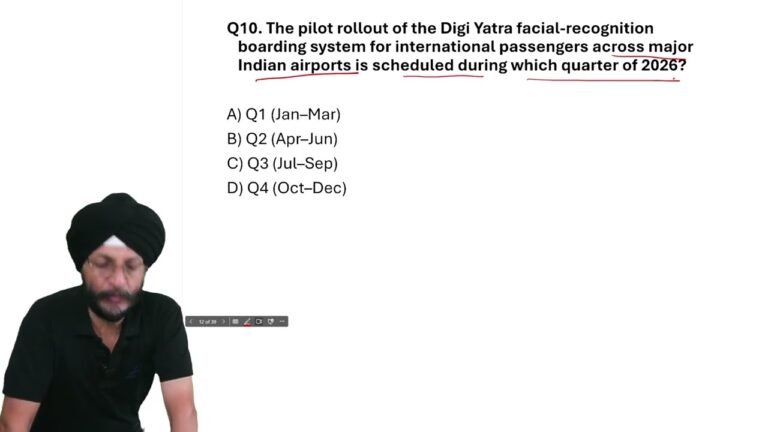
Digi Yatra International Rollout 2026 | Pilot Launch in Q4 | Current Affairs
When will the pilot rollout of Digi Yatra’s facial-recognition boarding