
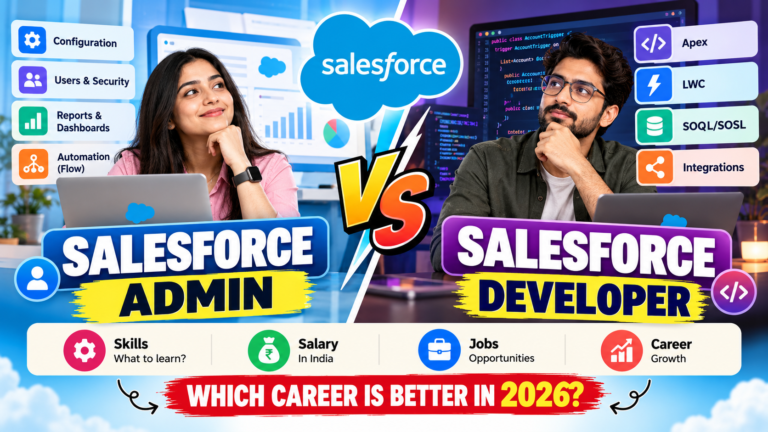
Salesforce Admin vs Salesforce Developer in 2026: Skills, Salary, Jobs & Which Career Is Better?
Choosing the right career path in Salesforce can be confusing, especially if you are a beginner. Two of the most popular career options in the Salesforce ecosystem are Salesforce Administrator and Salesforce Developer.
Both roles offer opportunities to work with one of the world’s leading customer relationship management (CRM) platforms. However, their responsibilities, technical requirements, daily activities, and career paths can be quite different.
A Salesforce Administrator primarily configures Salesforce, manages users, maintains data, creates reports, and automates business processes. A Salesforce Developer, on the other hand, writes code, builds custom applications, creates integrations, and implements complex business requirements.
But which role is better in 2026? Do you need coding skills to become a Salesforce professional? Which career is suitable for freshers? And which skills should you learn to improve your job prospects?
In this guide, we will compare Salesforce Admin and Salesforce Developer roles, explore their skills and responsibilities, discuss salary factors, and explain how to choose the right Salesforce career path.
## What Is a Salesforce Administrator?
A Salesforce Administrator is responsible for configuring, maintaining, and optimizing a Salesforce organization to support business operations.
Administrators help sales, service, and other business teams use Salesforce efficiently. They manage access, organize data, build automation, and ensure that the platform supports business requirements.
The role often involves working closely with users, managers, and business stakeholders.
### Key Responsibilities of a Salesforce Admin
A Salesforce Administrator may perform tasks such as:
– Creating and managing users
– Configuring profiles and permission sets
– Managing roles and sharing rules
– Creating custom objects and fields
– Building reports and dashboards
– Managing data imports and exports
– Creating validation rules
– Building Salesforce Flows
– Troubleshooting user issues
– Maintaining data quality
– Supporting business processes
For example, a company may want to automatically create a follow-up task whenever an Opportunity reaches a particular stage.
A Salesforce Administrator can often build this automation using Salesforce Flow without writing custom code.
### Skills Required for Salesforce Admin
To become a Salesforce Administrator, focus on:
1. Salesforce fundamentals
2. Objects, fields, and relationships
3. Profiles and permission sets
4. Roles and sharing rules
5. Reports and dashboards
6. Data management
7. Validation rules
8. Salesforce Flow
9. Problem-solving
10. Communication and documentation
Coding is not generally required for many entry-level administration tasks. However, understanding basic technical concepts and knowing when Apex is needed can make an Administrator more effective.
## What Is a Salesforce Developer?
A Salesforce Developer creates customized solutions on the Salesforce platform using programming and development tools.
Developers work on requirements that may go beyond standard Salesforce configuration. They build custom functionality, develop user interfaces, integrate external systems, and implement complex business logic.
### Key Responsibilities of a Salesforce Developer
A Salesforce Developer may be responsible for:
– Writing Apex classes
– Developing Apex triggers
– Creating Lightning Web Components (LWC)
– Writing SOQL and SOSL queries
– Implementing REST and SOAP integrations
– Creating automated tests
– Debugging code
– Managing asynchronous processing
– Improving application performance
– Supporting deployments
– Following Salesforce security and governor limits
For example, suppose a company needs to calculate a complex commission amount using multiple business rules and integrate the calculation with an external financial system.
A Salesforce Developer may use Apex and APIs to implement the required functionality.
### Skills Required for Salesforce Developers
Important skills include:
1. Salesforce fundamentals
2. Apex programming
3. Object-oriented programming concepts
4. SOQL and SOSL
5. Triggers
6. DML operations
7. Lightning Web Components
8. JavaScript, HTML, and CSS
9. REST and SOAP APIs
10. Test classes and debugging
11. Salesforce governor limits
12. Data security and application design
Developers should also understand declarative tools such as Flow because real-world Salesforce projects frequently combine configuration and code.
## Salesforce Admin vs Salesforce Developer: Key Differences
The following table summarizes the main differences between the two roles.
| Area | Salesforce Admin | Salesforce Developer |
|—|—|—|
| Main focus | Configuration and platform management | Custom development and technical solutions |
| Coding | Not always required | Usually essential |
| Main tools | Setup, Flow, Reports, Dashboards | Apex, LWC, SOQL, APIs |
| Data management | User access, imports, data quality | Data processing and programmatic operations |
| Automation | Flow and declarative tools | Flow, Apex, and custom logic |
| Typical work | Configure and maintain Salesforce | Build and extend Salesforce functionality |
| Best suited for | People interested in configuration and business processes | People interested in programming and technical problem-solving |
| Career progression | Senior Admin, Consultant, Architect | Senior Developer, Technical Lead, Architect |
These are general distinctions. In practice, responsibilities can overlap depending on the company, project, and level of experience.
## Which Salesforce Career Is Better in 2026?
There is no single answer because the better role depends on your interests and strengths.
### Choose Salesforce Admin If You:
– Prefer configuration over extensive coding
– Enjoy solving business problems
– Like working with users and stakeholders
– Are interested in reports and dashboards
– Want to learn business automation
– Enjoy organizing data and managing systems
Salesforce Admin can be a practical starting point for people who want to enter the ecosystem without immediately learning advanced programming.
### Choose Salesforce Developer If You:
– Enjoy programming
– Like solving technical problems
– Want to build custom applications
– Are interested in APIs and integrations
– Enjoy working with code
– Want to develop deeper technical expertise
Development may be a better fit if you enjoy programming and want to work on complex technical requirements.
### Can You Become Both?
Yes. You can begin with Salesforce Administration and later move into development.
Learning administration first can help you understand the Salesforce data model, security, automation, and business processes before moving into Apex and LWC.
You can also learn both tracks in parallel if you have enough time and a clear learning plan.
## Salesforce Admin vs Developer Salary in 2026
Salary is an important consideration when choosing a career. However, there is no fixed salary difference that applies to every Salesforce Administrator and Developer.
Compensation varies according to:
– Location
– Experience
– Company size
– Industry
– Technical expertise
– Certifications
– Project experience
– Communication skills
– Specialization
– Interview performance
An experienced Administrator with strong automation and consulting skills may earn more than a less-experienced Developer. Similarly, a Developer with advanced integration and architecture experience may qualify for higher-paying technical roles.
For the Indian job market, research current vacancies in your target city and compare salaries for similar experience levels. Treat online salary estimates as indicative rather than guaranteed.
Instead of choosing a role based only on salary, consider which skills you can develop deeply and demonstrate through real projects.
## Certifications for Salesforce Admins and Developers
Certifications can help validate your knowledge and demonstrate commitment to professional development.
### Certifications for Salesforce Administrators
The Salesforce Administrator certification is a common starting point.
Depending on your goals and experience, you can later explore advanced administration, platform app-building, or consultant-focused credentials.
### Certifications for Salesforce Developers
Developers can explore Salesforce development-focused certifications and credentials related to platform development.
Experienced developers may eventually consider architecture-focused certifications.
### Should You Get Certified First?
Certification can help structure your learning, but passing an exam does not automatically make you job-ready.
Combine certification preparation with hands-on practice, practical projects, and scenario-based interview preparation.
Always verify current exam names and requirements through Salesforce’s official certification resources before registering.
## Career Roadmap for Salesforce Admins
If you want to become a Salesforce Administrator, follow this roadmap.
### Step 1: Learn Salesforce Fundamentals
Understand CRM concepts, Salesforce navigation, objects, fields, records, and relationships.
### Step 2: Learn Security
Study users, profiles, permission sets, roles, sharing rules, and field-level security.
### Step 3: Learn Reports and Dashboards
Practice creating reports, filtering records, grouping data, and building dashboards.
### Step 4: Master Salesforce Flow
Learn Record-Triggered Flows, Screen Flows, decisions, assignments, record operations, and fault handling.
### Step 5: Build Projects
Create practical projects such as:
– Lead Management System
– Employee Onboarding System
– Customer Support Management
– Opportunity Follow-Up Automation
### Step 6: Prepare for Interviews
Practice explaining concepts and solving real-world business scenarios.
## Career Roadmap for Salesforce Developers
If your goal is Salesforce Development, use a structured learning path.
### Step 1: Learn Salesforce Fundamentals
Understand objects, fields, relationships, security, and declarative automation.
### Step 2: Learn Programming Basics
Study variables, data types, conditions, loops, methods, classes, and object-oriented programming.
### Step 3: Learn Apex
Practice classes, triggers, collections, DML, exception handling, asynchronous Apex, and test classes.
### Step 4: Learn SOQL and SOSL
Understand how to retrieve and search Salesforce data efficiently.
### Step 5: Learn Lightning Web Components
Study JavaScript, HTML, CSS, component structure, events, and communication between components.
### Step 6: Learn Integrations
Explore APIs, JSON, authentication concepts, and integration patterns.
### Step 7: Build Real Projects
Develop solutions that combine configuration, automation, Apex, and user interfaces.
### Step 8: Prepare for Technical Interviews
Practice coding questions, debugging, governor limits, bulkification, security, and real-world scenarios.
## How AI Is Changing Salesforce Admin and Developer Careers
AI is changing how Salesforce professionals approach business automation and application development.
Salesforce’s AI capabilities, including Agentforce, create opportunities to build solutions that combine CRM data, automation, and AI-powered interactions.
Administrators may increasingly work on improving data quality, designing workflows, and supporting AI-enabled business processes.
Developers may use AI-assisted tools while continuing to work on integrations, custom logic, security, testing, and architecture.
Neither role should be viewed as automatically disappearing because of AI. Instead, professionals should learn how AI fits into their work and understand its limitations.
A useful skill combination for 2026 is:
**Salesforce Fundamentals + Flow + Data + Security + AI Awareness**
Developers can extend this combination with Apex, LWC, APIs, and advanced technical skills.
## Common Mistakes to Avoid When Starting a Salesforce Career
### 1. Learning Only Theory
Watching tutorials is not enough. Build projects to understand how Salesforce works in practice.
### 2. Ignoring Salesforce Flow
Flow is an important automation tool for both Administrators and Developers.
### 3. Memorizing Interview Answers
Interviewers often ask scenario-based questions. Learn how to solve problems instead of memorizing definitions.
### 4. Collecting Certifications Without Practical Skills
Certifications can support your profile, but practical knowledge is equally important.
### 5. Trying to Learn Every Salesforce Technology at Once
Start with fundamentals and build toward your chosen specialization.
## Final Verdict: Salesforce Admin or Developer?
Salesforce Admin and Salesforce Developer are both valuable career paths, but they suit different interests.
If you enjoy configuration, data management, business processes, reporting, and automation, Salesforce Administration may be the right starting point.
If you enjoy coding, application development, integrations, and complex technical problem-solving, Salesforce Development may be a better fit.
If you are unsure, begin with Salesforce fundamentals and build a small Flow project. Then try a basic Apex program. Comparing the two experiences can help you decide which direction you enjoy most.
The best career is not necessarily the one with the most impressive title. It is the one in which you can build valuable skills, solve real problems, and continue learning.
For beginners, the most important first step is to start learning, practice consistently, and build projects that demonstrate what you can do.
## Frequently Asked Questions
### 1. Is Salesforce Admin easier than Salesforce Developer?
Administration generally involves less programming, so it can be more accessible to beginners without a coding background. However, advanced administration still requires strong knowledge of security, automation, data, and business processes.
### 2. Can a fresher become a Salesforce Developer?
Yes. Freshers can pursue Salesforce development by learning the platform fundamentals, Apex, SOQL, LWC, testing, and practical project development.
### 3. Is coding compulsory for Salesforce Admin?
Coding is not compulsory for many administration responsibilities. Administrators can handle many requirements using configuration and declarative automation.
### 4. Which role has better career growth?
Both roles offer career growth. Administrators can progress into consulting, advanced administration, and architecture. Developers can progress into senior development, technical leadership, and architecture.
### 5. Should I learn Flow before Apex?
Learning Flow first is useful because it introduces automation and business logic visually. Developers should also learn Apex to handle requirements that need custom code.
### 6. Can a Salesforce Admin become a Developer?
Yes. An Administrator can transition into development by learning programming fundamentals, Apex, SOQL, triggers, LWC, APIs, and testing.
### 7. What is the best way to get a Salesforce job?
Build practical projects, learn the skills required for your target role, prepare for scenario-based interviews, create a focused resume, and apply for relevant opportunities.
Newsletter
Recent Posts
Salesforce Flow vs Apex in 2026: Key Differences, Examples & When to Use Each
Salesforce offers powerful tools to automate business processes, and
Salesforce Admin vs Salesforce Developer in 2026: Skills, Salary, Jobs & Which Career Is Better?
Choosing the right career path in Salesforce can be

2026 Nobel Prize Breakthroughs Explained 🏆 | Science Current Affairs #Shorts
What are the major scientific breakthroughs behind the 2026 Nobel

Asian Games 2030 Host City Revealed! 🏆 | Doha, Qatar | Current Affairs #Shorts
Which city will host the Asian Games 2030? Test your