
Salesforce Agentforce in 2026: Why AI Skills Are Becoming Essential for Salesforce Professionals
For years, Salesforce professionals focused on Salesforce Administration, Apex, Lightning Web Components (LWC), Flow, automation, integrations, reports, dashboards, and data management. These skills remain important, but the Salesforce ecosystem is rapidly expanding toward artificial intelligence and autonomous business workflows.
One of the biggest developments shaping Salesforce in 2026 is Agentforce, Salesforce’s platform for building and deploying AI agents that can work with business context, customer data, workflows, and defined actions.
For students, freshers, working professionals, Salesforce Admins, Developers, Consultants, and CRM professionals, this creates an important question:
Should you learn AI and Agentforce along with traditional Salesforce skills?
The answer depends on your career path, but understanding Agentforce is becoming increasingly relevant for professionals who want to work with the modern Salesforce platform.
## What Is Salesforce Agentforce?
Salesforce Agentforce is a platform for creating AI agents that can work with Salesforce data, business processes, workflows, and applications.
Traditional automation generally follows predefined instructions.
For example:
If Opportunity Stage = Closed Won → Update Account → Create Task.
This is predictable automation because the logic is explicitly configured.
An AI agent can operate differently. It can understand a user’s request, use available information and actions, and respond or perform permitted tasks according to configured business rules.
For example, a sales representative might ask:
“Show me the opportunities that need attention this week.”
An AI-powered system can help analyze relevant information and surface opportunities requiring attention.
Another example could be customer service.
A customer might ask:
“My order has not arrived. Can you check the status?”
An agent can potentially understand the request, retrieve relevant information, provide an answer, and escalate the situation when human intervention is required.
This combination of natural-language interaction, business context, data, and actions is what makes AI agents different from simple rule-based automation.
## Why Agentforce Is Trending in 2026
Artificial intelligence is moving beyond content generation and simple question answering.
Businesses are increasingly exploring AI systems that can assist with actual business processes.
Salesforce is investing heavily in AI agents, data connectivity, automation, and agentic workflows. This is changing the way organizations think about CRM platforms.
Instead of CRM being only a place where employees store customer information, modern CRM platforms can increasingly become environments where humans, automation, data, and AI work together.
This creates new opportunities for Salesforce professionals.
Professionals who understand Salesforce fundamentals and then add AI-related capabilities can build a broader technology skill set.
## Agentforce vs Traditional Salesforce Automation
It is important to understand the difference between traditional automation and AI agents.
Traditional Salesforce automation works according to predefined rules.
For example:
Lead Created → Check Lead Source → Assign Owner → Send Notification.
The administrator or developer defines each step.
AI agents introduce a more flexible interaction model.
For example:
Customer Request → Understand Intent → Access Relevant Information → Perform Permitted Action → Respond or Escalate.
The agent can interpret the request and determine which available action is relevant.
However, this does not mean traditional automation is becoming irrelevant.
In many business scenarios, AI and automation can work together.
A business may use an AI agent to understand what the user wants and then use Flow or Apex to execute a controlled business process.
Therefore, the future is not necessarily:
Automation OR AI
Instead, it can increasingly be:
Automation + AI
## Salesforce Flow and Agentforce
Salesforce Flow remains an important technology for automation.
Suppose a customer requests an address update.
The AI agent can understand the customer’s request.
The Salesforce Flow can then perform the predefined process for updating the appropriate record.
The workflow could look like this:
User Request
↓
AI Agent
↓
Identify Intent
↓
Invoke Appropriate Action
↓
Salesforce Flow
↓
Update Record
↓
Confirmation
This approach combines conversational intelligence with structured business automation.
For Salesforce professionals, understanding how Flow and AI agents can work together can become an important skill.
## Why Salesforce Data Matters for AI
AI depends heavily on information and context.
Imagine a company has thousands of customer records, but those records contain:
Duplicate records
Missing information
Incorrect contact details
Outdated addresses
Inconsistent fields
Disconnected systems
Poor data quality
Simply adding an AI agent does not automatically solve these problems.
This is why data management continues to be an important Salesforce skill.
Salesforce professionals should understand:
Data Quality
Data Security
Data Access
Data Modeling
Data Integration
Data Governance
Customer Context
AI Grounding
The better the underlying data and business context, the more useful an AI-powered solution can become.
## What Is Data 360?
Data 360 is an important part of Salesforce’s broader data strategy.
Organizations often have customer information spread across different systems.
For example:
Salesforce CRM
Marketing Platforms
Customer Service Systems
Data Warehouses
Web Applications
External Databases
Documents
Third-Party Applications
Connecting these sources can provide a more complete view of the customer.
For AI systems, this becomes especially important because agents need relevant business context to provide useful responses and perform appropriate actions.
This means Salesforce professionals should not focus only on AI.
They should also understand the data that powers AI.
## Skills Salesforce Professionals Should Learn in 2026
The Salesforce skill set is expanding.
A modern learning roadmap can include several layers.
### 1. Salesforce Administration
Beginners should start with the fundamentals.
Important topics include:
Objects
Fields
Relationships
Users
Profiles
Permission Sets
Roles
Sharing Rules
Validation Rules
Reports
Dashboards
Data Management
Security
These concepts create the foundation for understanding Salesforce.
### 2. Salesforce Flow
Flow is one of the most important automation tools in Salesforce.
Professionals should understand:
Record-Triggered Flow
Screen Flow
Scheduled Flow
Get Records
Create Records
Update Records
Delete Records
Decision Elements
Loops
Collections
Variables
Fault Handling
Debugging
Flow can automate business processes and can also become part of larger AI-powered workflows.
### 3. Apex Development
Developers should understand Apex fundamentals such as:
Classes
Methods
Variables
Collections
SOQL
SOSL
DML
Triggers
Exception Handling
Governor Limits
Test Classes
Asynchronous Apex
Apex remains useful for complex business logic and custom Salesforce functionality.
### 4. Lightning Web Components
Lightning Web Components are important for Salesforce developers building modern user interfaces.
Important topics include:
HTML
CSS
JavaScript
LWC
Component Communication
Events
Wire Service
Apex Integration
Lightning Data Service
Developers can combine LWC with Apex, Salesforce data, APIs, and AI-powered functionality.
### 5. APIs and Integrations
Modern Salesforce environments rarely operate completely in isolation.
Businesses often need Salesforce to communicate with external applications.
Professionals should understand concepts such as:
REST API
SOAP API
Webhooks
External Services
Authentication
JSON
HTTP
Integration Patterns
API-based integrations become even more important when AI agents need access to information outside the CRM.
### 6. Data Skills
Data is becoming increasingly important in the AI era.
Salesforce professionals should understand:
Data Modeling
Data Quality
Data Migration
Data Security
Data Integration
Data Governance
Customer Data
External Data
Data Connectivity
Good data provides the foundation for useful AI experiences.
### 7. Agentforce
Professionals interested in Salesforce AI should become familiar with concepts such as:
AI Agents
Agent Actions
Instructions
Topics
Agent Orchestration
Agent Testing
Guardrails
Human Handoff
Agent Monitoring
AI Governance
The goal is not simply to create an AI chatbot.
The goal is to design an AI-powered business process that can operate safely and effectively within an organization’s requirements.
## The Role of Salesforce Admins in the AI Era
The rise of AI does not eliminate the importance of Salesforce Administration.
Instead, the role can evolve.
A modern Salesforce Admin may need to understand:
User Access
Permissions
Data Security
Flow Automation
Reports
Dashboards
Data Quality
AI Features
Agent Configuration
Governance
Testing
Imagine a company wants to introduce an AI agent for customer support.
Someone still needs to understand:
Which data can the agent access?
Which users can access that information?
Which actions should the agent be allowed to perform?
What happens when the agent cannot solve a problem?
When should the request be transferred to a human?
How should the process be monitored?
These questions require Salesforce knowledge.
## The Role of Salesforce Developers in the AI Era
Developers are also adapting to the changing Salesforce ecosystem.
A modern Salesforce Developer may work with:
Apex
SOQL
LWC
APIs
Integrations
Flow
Data
AI
Agentforce
Instead of only writing custom code, developers may increasingly work on systems where AI agents interact with existing Salesforce functionality.
For example:
AI Agent
↓
Business Action
↓
Apex
↓
Salesforce Data
↓
External API
↓
Business Response
This requires developers to understand both traditional development and newer AI capabilities.
## Should Salesforce Developers Learn AI?
For developers who want to remain current with the Salesforce ecosystem, learning practical AI concepts can be valuable.
You do not necessarily need to become a machine-learning engineer.
Instead, understand practical concepts such as:
Generative AI
Large Language Models
Prompt Engineering
Context
Grounding
AI Hallucinations
AI Security
AI Governance
Human-in-the-Loop
Agent Testing
The objective is to understand how AI can be applied to real Salesforce business problems.
## Salesforce Career Roadmap for Freshers
If you are a fresher, do not try to learn everything at the same time.
A structured roadmap can be more effective.
Start with:
Salesforce Fundamentals
↓
Salesforce Administration
↓
Data Management
↓
Salesforce Flow
↓
Reports and Dashboards
↓
Apex or Advanced Administration
↓
LWC and Integrations
↓
AI Concepts
↓
Agentforce
This gives you a strong foundation before moving into advanced technologies.
## Salesforce Career Roadmap for Working Professionals
Working professionals can adapt the roadmap based on their existing experience.
If you are already a Salesforce Admin:
Admin
↓
Flow
↓
Advanced Automation
↓
Data
↓
AI
↓
Agentforce
If you are a Salesforce Developer:
Apex
↓
LWC
↓
Integration
↓
APIs
↓
Data
↓
AI
↓
Agentforce
If you are a Business Analyst:
Business Processes
↓
Salesforce
↓
Automation
↓
Data
↓
AI Use Cases
↓
Agentforce
If you are a Consultant:
CRM Strategy
↓
Salesforce Architecture
↓
Data
↓
Automation
↓
AI
↓
Governance
The objective is not to learn every Salesforce technology.
The objective is to build skills that support your desired career path.
## Why Practical Salesforce Projects Matter
One of the biggest mistakes learners make is focusing only on theory.
Learning what a Flow is and actually building a Flow are two different experiences.
The same applies to Apex, LWC, integrations, and AI.
Practical projects allow you to understand how different technologies work together.
For example, you could create a Customer Support Management System.
The project could include:
Customer Object
Product Object
Order Object
Case Object
Flow Automation
Apex Logic
LWC Dashboard
External API
AI Agent
Human Escalation
This single project can help demonstrate multiple Salesforce concepts.
## Project Idea: AI Customer Support System
Imagine a company receives hundreds of customer questions every day.
A Salesforce-based solution could be designed as follows:
Customer
↓
AI Agent
↓
Understand Customer Question
↓
Search Relevant Information
↓
Check Salesforce Data
↓
Provide Response
↓
Create Case if Required
↓
Escalate to Human
This type of project demonstrates how AI and Salesforce can work together.
It also introduces learners to an important enterprise concept:
AI should not necessarily handle everything.
Some situations may require human intervention.
## Project Idea: AI Sales Assistant
Another useful project is an AI-powered sales assistant.
A sales representative could ask:
“Which opportunities require follow-up?”
The system could use relevant Salesforce information to help identify opportunities that need attention.
The workflow could involve:
Opportunity Data
↓
AI Assistance
↓
Identify Relevant Records
↓
Generate Suggested Next Step
↓
Sales Representative Review
↓
Action
This demonstrates the concept of AI assisting employees rather than simply replacing existing processes.
## Project Idea: Lead Qualification
Another project could focus on lead management.
A basic workflow could be:
New Lead
↓
Collect Information
↓
AI-Assisted Qualification
↓
Determine Relevant Category
↓
Assign Lead
↓
Create Follow-Up Task
↓
Notify Sales Team
This can combine Salesforce records, Flow automation, business rules, and AI capabilities.
## AI Governance in Salesforce
As AI becomes more powerful, governance becomes increasingly important.
Businesses need to define:
What data can AI access?
What information should remain restricted?
Which actions can an agent perform?
Which actions require approval?
How should sensitive information be handled?
What happens when an AI response is incorrect?
When should a human take over?
These questions are particularly important in enterprise environments.
Salesforce professionals therefore need to understand not only how to build AI-powered solutions but also how to design appropriate controls.
## Human + AI Collaboration
The future of Salesforce does not necessarily mean humans disappear from the workflow.
In many situations, AI can assist people while humans remain responsible for important decisions.
For example:
AI identifies a potential customer issue.
↓
AI gathers relevant information.
↓
AI suggests an action.
↓
Employee reviews the information.
↓
Employee approves the action.
This type of workflow can combine the speed of AI with human oversight.
Understanding when AI should act and when humans should remain involved is an important part of designing responsible business systems.
## Common Mistakes Salesforce Learners Should Avoid
### Mistake 1: Learning Only Theory
Watching tutorials is not enough.
Build projects.
### Mistake 2: Ignoring Fundamentals
Don’t skip Salesforce fundamentals simply because AI is trending.
### Mistake 3: Ignoring Data
AI solutions depend on reliable and relevant information.
### Mistake 4: Avoiding Flow
Flow remains an important part of Salesforce automation.
### Mistake 5: Focusing Only on Certification
Certification can demonstrate knowledge, but practical implementation skills are also important.
### Mistake 6: Learning Without a Career Goal
An Admin, Developer, Consultant, and Architect may need different skill combinations.
Choose a direction and build the right skills around it.
## Salesforce Agentforce and the Future of CRM
CRM platforms are becoming increasingly intelligent.
Traditional CRM systems primarily helped organizations store and manage customer information.
Modern CRM environments are expanding toward:
Customer Data
*
Automation
*
AI
*
Agents
*
Integrations
*
Human Collaboration
This creates a much broader technology ecosystem.
Salesforce professionals who understand how these components connect can approach business problems from a more complete perspective.
Instead of asking only:
“How do I configure this Salesforce feature?”
Professionals may increasingly need to ask:
“What is the best way to solve this business problem using Salesforce, automation, data, and AI?”
That is a much broader skill.
## Is Salesforce Still Relevant in 2026?
Salesforce continues to evolve across CRM, automation, data, development, and artificial intelligence.
The platform is not standing still.
As technology changes, Salesforce professionals need to keep learning.
The skills that remain important include:
CRM Fundamentals
Salesforce Administration
Automation
Data Management
Development
Integration
Security
AI
Agentforce
The exact combination depends on the individual’s career goals.
For beginners, fundamentals remain the starting point.
For experienced professionals, expanding into AI, data, and agentic workflows can help broaden their technical capabilities.
## How to Prepare for a Salesforce Career
If you are serious about building a Salesforce career, create a learning plan.
Start with Salesforce fundamentals.
Learn Administration.
Practice Flow.
Understand data and security.
Choose Admin, Developer, Consultant, or another specialization.
Build practical projects.
Learn APIs and integrations where relevant.
Then explore AI and Agentforce.
Most importantly, continue practicing.
Technology changes quickly, so continuous learning is becoming an important part of a modern Salesforce career.
## Frequently Asked Questions
### What is Salesforce Agentforce?
Salesforce Agentforce is a platform for creating AI agents that can interact with users, use business context, and perform configured actions across Salesforce processes and data.
### Is Agentforce replacing Salesforce Admins?
Salesforce Administration remains important because organizations still need people who understand data, security, permissions, automation, configuration, and governance.
### Should Salesforce Developers learn Agentforce?
Developers interested in the evolving Salesforce ecosystem can add Agentforce and AI concepts to their existing Apex, LWC, integration, and automation skills.
### Do I need Apex before learning Agentforce?
Not necessarily. The required skills depend on the type of Agentforce work you want to perform. However, Apex and other Salesforce development skills can become useful for more advanced implementations.
### What should a Salesforce fresher learn first?
A beginner should generally start with Salesforce fundamentals, CRM concepts, Administration, data, automation, and then choose a specialization.
### Is Salesforce a good career for freshers?
Salesforce offers a broad ecosystem of roles and technologies. Career outcomes depend on skills, practical experience, specialization, location, and market conditions. Building strong fundamentals and practical projects is important.
### What is the future of Salesforce?
Salesforce is increasingly combining CRM, data, automation, AI, integrations, and AI agents. Professionals who understand how these technologies work together can prepare for the evolving Salesforce ecosystem.
## Final Thoughts
Salesforce is entering an exciting stage of technological development.
AI agents, Agentforce, Data 360, Flow, Apex, LWC, APIs, integrations, and automation are becoming increasingly connected.
But the fundamentals still matter.
The modern Salesforce skill stack can be represented as:
Salesforce CRM
*
Administration
*
Automation
*
Development
*
Data
*
AI
For beginners, start with the foundation.
For Admins, strengthen automation, data, security, and AI knowledge.
For Developers, expand into integrations, AI, and Agentforce.
For Consultants, focus on business processes and complete solution design.
For working professionals, continuously upgrade your existing Salesforce expertise.
The future of Salesforce is not simply about learning another tool.
It is about understanding how technology can solve real business problems.
Build the foundation.
Learn the technology.
Work on real projects.
Understand AI.
Keep evolving.
That is the mindset that can help you prepare for the next generation of Salesforce opportunities.
**Prabh Kirpa Classes — Learn Salesforce. Build Skills. Prepare for the Future.**
Newsletter
Recent Posts
Salesforce Career in 2026: Complete Roadmap, Skills, Jobs, Salary Factors and How to Become Job-Ready
Salesforce continues to be one of the most widely used
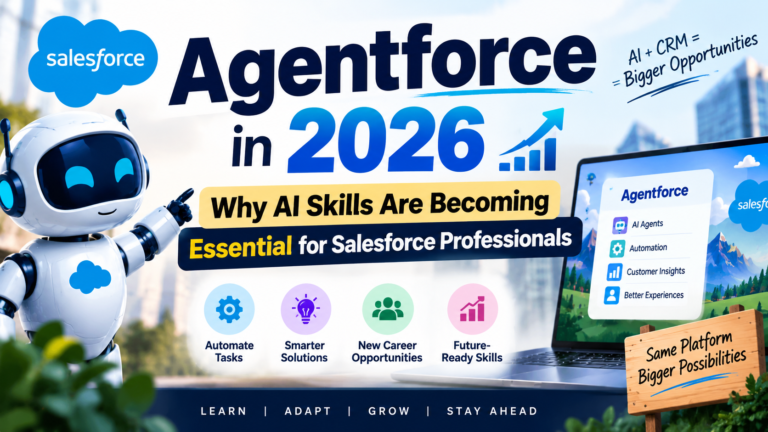
Salesforce Agentforce in 2026: Why AI Skills Are Becoming Essential for Salesforce Professionals
For years, Salesforce professionals focused on Salesforce Administration, Apex,

China Warns of New Space Arms Race | Current Affairs 2026
China has warned that the deployment of US military weapons
Why Is the Indian Rupee Weakening in September 2026? | Key Factors Explained
Why has the Indian rupee continued to remain weak in