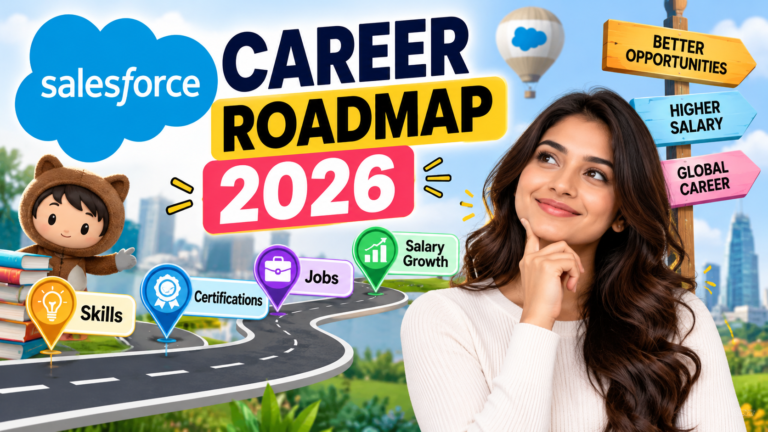
Salesforce Career Roadmap 2026: Skills, Certifications, Jobs and Salary Growth
## Introduction
Salesforce is one of the leading CRM platforms used by businesses to manage customer relationships, automate processes, and improve productivity. As companies increasingly adopt cloud technology and AI-powered solutions, Salesforce skills can open up career opportunities for freshers and working professionals.
If you want to start a career in Salesforce or switch to a technology role, understanding the right skills, certifications, and career path is essential.
In this guide, we will explore Salesforce career options, important technical skills, certifications, and practical steps to become job-ready in 2026.
## What Is Salesforce?
Salesforce is a cloud-based Customer Relationship Management (CRM) platform that helps businesses manage sales, customer service, marketing, and business processes.
It offers tools for customizing applications, automating workflows, managing customer data, and developing business solutions.
Some important Salesforce technologies include:
– Salesforce Administration
– Salesforce Development using Apex
– Lightning Web Components (LWC)
– Salesforce Flow and Automation
– Reports and Dashboards
– Salesforce Integration
– Agentforce and AI-powered CRM capabilities
## Why Choose a Salesforce Career in 2026?
Salesforce offers several career paths for people interested in technology, business analysis, and cloud computing.
Key advantages include:
– Multiple career paths for beginners and experienced professionals
– Opportunities in CRM implementation and consulting
– Skills applicable across different industries
– Opportunities to specialize in automation, development, integration, and AI
– Career-switching opportunities for professionals with relevant experience
Your career growth will depend on practical skills, project experience, communication abilities, and the requirements of employers.
## Top Salesforce Career Options
### 1. Salesforce Administrator
A Salesforce Administrator manages users, permissions, records, reports, dashboards, and automation.
Important skills:
– User and profile management
– Roles and permission sets
– Objects, fields, and relationships
– Reports and dashboards
– Validation rules
– Salesforce Flow
### 2. Salesforce Developer
A Salesforce Developer builds customized business solutions using Salesforce programming tools.
Important skills:
– Apex programming
– SOQL and SOSL
– Triggers and classes
– Lightning Web Components
– Governor limits
– Test classes and debugging
### 3. Salesforce Business Analyst
A Salesforce Business Analyst understands business requirements and translates them into technical or functional solutions.
Important skills:
– Requirement gathering
– Business process mapping
– User stories
– Functional documentation
– Salesforce configuration
– Stakeholder communication
### 4. Salesforce Consultant
A Salesforce Consultant helps businesses implement and optimize Salesforce according to their requirements.
Important skills:
– CRM implementation
– Business process analysis
– Salesforce configuration
– Automation design
– Data management
– Client communication
### 5. Salesforce AI Specialist
Salesforce professionals can also explore AI-related roles involving Agentforce, AI-assisted workflows, and intelligent CRM solutions.
Important skills:
– Salesforce platform fundamentals
– Flow and automation
– Agentforce concepts
– Data quality and access controls
– AI use cases and testing
## Salesforce Learning Roadmap for Beginners
Follow this structured roadmap to build your foundation.
**Step 1: Learn CRM Fundamentals**
Understand CRM concepts, Salesforce navigation, objects, records, and the platform’s basic functionality.
**Step 2: Master Salesforce Administration**
Learn users, security, fields, relationships, validation rules, reports, dashboards, and Salesforce Flow.
**Step 3: Practise Real Projects**
Build projects such as a student management system, sales tracking application, or customer support management system.
**Step 4: Learn Apex and LWC**
If you want to pursue development, study programming fundamentals, Apex, SOQL, triggers, and Lightning Web Components.
**Step 5: Explore Integration and AI**
Learn APIs and integration concepts, then explore Agentforce and AI-enabled Salesforce capabilities as appropriate for your career path.
**Step 6: Prepare for Interviews**
Practise scenario-based questions, explain your projects clearly, revise technical concepts, and prepare a professional resume.
## Which Salesforce Certification Should You Choose?
Your first certification should match your intended career path.
– **Administrator:** Suitable for learning platform configuration and CRM management.
– **Platform Developer I:** Suitable for candidates developing their Salesforce programming skills.
– **Business Analyst:** Suitable for candidates focused on requirements and business processes.
– **Advanced role-specific certifications:** Consider these after gaining relevant foundational knowledge and experience.
Always verify current exam requirements and certification details through official Salesforce resources before booking an exam.
## How to Build a Salesforce Project Portfolio
A strong portfolio helps demonstrate that you can apply what you learn.
Consider building these projects:
1. Student Admission Management System
2. Sales Pipeline and Opportunity Tracking System
3. Customer Support Case Management System
4. Automated Approval Process Using Salesforce Flow
5. Custom Salesforce Application Using Apex and LWC
Document the business problem, features, configuration, automation, and testing for each project. Add screenshots or a project walkthrough where appropriate.
## Salesforce Salary and Career Growth
Salesforce salaries vary based on location, experience, specialization, employer, and practical skills. Administration, development, consulting, integration, and AI-related roles may have different compensation structures.
Instead of choosing a career path based only on salary, evaluate your interests, technical aptitude, and the skills required in job descriptions.
To improve your prospects, focus on hands-on projects, interview preparation, communication skills, and continuous learning.
## How Prabh Kirpa Classes Can Help
Prabh Kirpa Classes supports learners who want to develop their Salesforce knowledge through structured training in Salesforce Administration, Development, Apex, LWC, Flow, and Automation.
Whether you are a fresher building your foundation or a working professional looking to upgrade your skills, focus on practical learning, project development, and interview preparation.
## Conclusion
A Salesforce career can be a valuable option for learners interested in CRM, cloud technology, automation, and application development.
Start with the fundamentals, choose a suitable career path, practise real-world projects, and develop the skills employers expect. Consistent practice and a clear learning roadmap can help you work towards becoming job-ready.
**Ready to start your Salesforce journey?** Explore Salesforce training with Prabh Kirpa Classes and take the next step towards building your technical skills.
Newsletter
Recent Posts
Salesforce Career Roadmap 2026: Skills, Certifications, Jobs and Salary Growth
## Introduction Salesforce is one of the leading CRM

Shinzo Abe Memorial Corridor 🇮🇳🇯🇵 | Where Was It Inaugurated? | Current Affairs MCQ
🇮🇳🇯🇵 Can you answer this important India–Japan current affairs question?

RBI CRR Update 2026 🏦 | New Cash Reserve Ratio Rule | Banking Current Affairs MCQ
🏦 Do you know the latest RBI update on the

Swimming World Record Alert 🏊 | Pieter Coetzee | Sports Current Affairs MCQ 2026
🏊🌍 A world record alert! Can you guess which country