
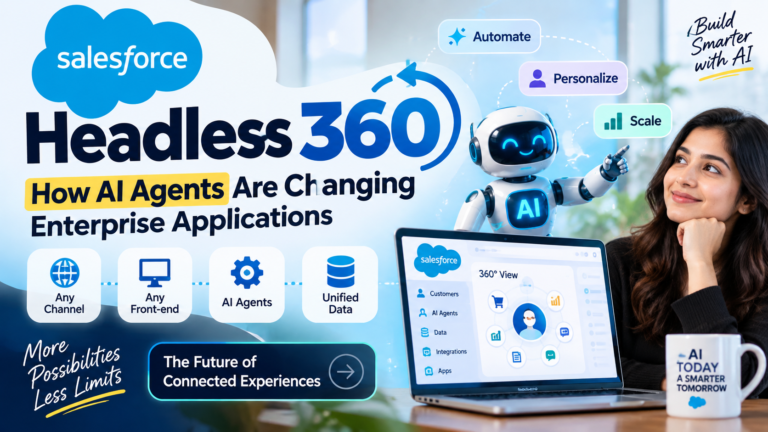
Salesforce Headless 360: How AI Agents Are Changing Enterprise Applications
The Salesforce ecosystem is entering a new era.
For years, Salesforce users primarily interacted with the platform through its user interface. Administrators configured Salesforce through Setup, developers worked with Apex and Lightning Web Components, sales teams managed opportunities, and customer service teams handled cases through Salesforce applications.
But artificial intelligence is changing how people interact with enterprise software.
Instead of opening an application, searching for information, clicking through multiple screens, and manually completing every step, users can increasingly interact with AI agents using natural language.
This shift is one of the key ideas behind **Salesforce Headless 360**.
Salesforce describes Headless 360 as an expansion of the platform that makes Salesforce capabilities available as reusable enterprise capabilities through APIs, Model Context Protocol (MCP), developer tools, and other interfaces. This allows authorized applications and AI agents to discover and use Salesforce capabilities while retaining established identity, permissions, workflows, and governance.
For Salesforce Admins, Developers, Consultants, and students, Headless 360 is an important concept to understand because it connects several major areas of modern Salesforce:
**Salesforce + APIs + AI Agents + MCP + Data + Automation + Security**
Let’s understand what Headless 360 means, how it works, why it matters, and what Salesforce professionals should learn.
# What Is Salesforce Headless 360?
The simplest way to understand Headless 360 is:
**Salesforce capabilities can be used without requiring users or AI agents to work through the traditional Salesforce interface.**
In a traditional Salesforce experience, a user might:
Open Salesforce
↓
Open an Account
↓
Find an Opportunity
↓
Update the Opportunity
↓
Create a Task
↓
Send an Email
This process requires the user to navigate through the Salesforce interface.
With headless capabilities, an application or AI agent can interact with Salesforce capabilities through programmatic interfaces.
For example, a user might ask an AI assistant:
**”Update the opportunity for ABC Company and create a follow-up task for tomorrow.”**
An authorized AI agent could potentially discover the required Salesforce capabilities, understand the available actions, and execute them through the appropriate interfaces.
Salesforce’s Headless 360 MCP Server is designed to let MCP-aware agents access Salesforce capabilities through a single connection, with the available operation library growing over time.
# What Does “Headless” Mean?
The term “headless” is not unique to Salesforce.
In software architecture, a headless system generally separates the backend capabilities from a specific frontend interface.
The backend provides functionality and data.
Different interfaces can then consume those capabilities.
For example:
**Backend**
↓
API
↓
Website
Mobile App
AI Agent
Chat Interface
Custom Application
This means the same underlying business functionality can be used in multiple experiences.
Salesforce’s own documentation explains that Headless 360 does not mean removing the Salesforce user interface. Instead, it expands where Salesforce capabilities can be used.
# Why Is Headless 360 Important?
The way people interact with software is changing.
Previously:
**Human → Application → Data → Action**
Increasingly:
**Human → AI Agent → Business Capability → Data → Action**
This does not mean traditional applications disappear.
Instead, applications become one of several ways to access enterprise capabilities.
For businesses, this can reduce the need to rebuild the same business logic for every new AI experience.
Salesforce says Headless 360 is designed to let organizations reuse existing business capabilities while preserving identity, permissions, metadata, workflows, governance, and business logic.
This is particularly important for large organizations with complex Salesforce environments.
# Headless 360 and AI Agents
AI agents are one of the major reasons Headless 360 is gaining attention.
An AI agent needs more than a language model.
It needs:
Context
Data
Tools
Actions
Permissions
Business Rules
Security
Governance
An AI agent may understand what a user wants, but it still needs a way to perform the required action.
For example:
User:
**”Create a follow-up task for my highest-priority opportunity.”**
The agent needs to:
1. Understand the request.
2. Identify the relevant opportunity.
3. Access Salesforce data.
4. Determine the correct action.
5. Create the task.
6. Respect the user’s permissions.
7. Return the result.
Headless capabilities provide the programmatic foundation through which such actions can be performed.
# What Is MCP?
To understand Headless 360, Salesforce professionals should also understand **Model Context Protocol**, commonly called MCP.
MCP is an open protocol designed to help AI applications connect with external tools and data sources in a standardized way.
Instead of every AI application creating a completely different integration for every external system, MCP provides a common approach for connecting models and agents with tools.
Salesforce has introduced hosted MCP servers that allow MCP-compatible clients to connect with Salesforce capabilities. Salesforce’s developer documentation describes the Headless 360 MCP Server as a way to expose Salesforce operations to MCP-aware agents.
This is important because AI agents increasingly need access to business systems.
# Headless 360 MCP Server
The Headless 360 MCP Server is particularly interesting for Salesforce Developers and Admins.
Instead of exposing thousands of individual tools to an AI model, Salesforce designed the server around four core tools:
**Discover**
**Describe**
**Dispatch**
**Dispatch Read Only**
The agent can first discover relevant capabilities, understand the required action, and then execute the appropriate operation.
Salesforce explains that this approach keeps the agent’s tool surface relatively small while allowing the underlying library of Salesforce operations to grow.
This is an important architectural idea.
Imagine an enterprise platform with thousands of possible operations.
Giving an AI model thousands of separate tools could create unnecessary complexity.
Instead, the agent can use a smaller set of mechanisms to discover and execute the required capability.
# How Headless 360 Works
A simplified workflow looks like this:
**User Request**
↓
**AI Agent**
↓
**Discover Capability**
↓
**Understand Action**
↓
**Check Permissions**
↓
**Execute Salesforce Action**
↓
**Return Result**
For example:
User:
“Create a new Salesforce user and assign the appropriate permission set.”
The agent can interpret the request and identify the required Salesforce operation.
The actual execution still needs to follow the security and permissions associated with the authenticated user.
# Security and Governance
Enterprise AI cannot simply be given unrestricted access to business systems.
Security is therefore one of the most important parts of Headless 360.
Salesforce states that Headless 360 MCP transactions run as the authenticated user and are subject to controls such as CRUD, field-level security, sharing rules, profiles, and permission sets. Salesforce also states that actions are attributed to the authenticated user in the audit trail.
This creates an important principle:
**AI should not automatically receive more permissions than the user or application is authorized to have.**
For Salesforce professionals, understanding security becomes even more important in an agentic environment.
# Headless 360 and Salesforce Security
Salesforce professionals should already understand concepts such as:
Profiles
Permission Sets
Permission Set Groups
Roles
Sharing Rules
Organization-Wide Defaults
Field-Level Security
Object Permissions
Record Access
These concepts remain relevant when AI agents interact with Salesforce.
The question becomes:
**What should the agent be allowed to do on behalf of the user?**
For example, an agent may be allowed to read an Opportunity but not delete it.
Another agent may be allowed to create Tasks but not modify user permissions.
This is why governance and access control are essential.
# Headless 360 and APIs
APIs have always been important in Salesforce.
Developers use APIs to connect Salesforce with external systems.
For example:
Salesforce
↓
REST API
↓
External Application
Or:
Salesforce
↓
Integration Platform
↓
ERP
↓
Payment System
Headless 360 expands this idea for an AI-driven environment.
Salesforce has described Headless 360 as making platform capabilities available through APIs, MCP tools, and CLI commands.
Therefore, API knowledge remains extremely valuable for Salesforce Developers.
# Headless 360 and Flow
Flow is another important part of this ecosystem.
Suppose an AI agent determines that a customer requires a particular business process.
The agent does not necessarily need to perform every individual operation itself.
Instead, it can trigger an established business process.
For example:
**AI Agent**
↓
**Invoke Action**
↓
**Salesforce Flow**
↓
**Validate Information**
↓
**Update Records**
↓
**Create Task**
↓
**Send Notification**
This approach combines AI reasoning with deterministic business automation.
Flow therefore remains an important skill for Salesforce professionals.
# Headless 360 and Apex
Apex also continues to have an important role.
Some business logic may require custom code.
For example:
**AI Agent**
↓
**Invoke Business Action**
↓
**Apex**
↓
**Custom Logic**
↓
**Salesforce Data**
↓
**External API**
Apex can therefore become part of the business capability that an AI agent accesses.
This means Salesforce Developers should continue learning:
Apex
SOQL
DML
Classes
Methods
Triggers
Test Classes
Governor Limits
Integrations
# Headless 360 and Lightning Web Components
Lightning Web Components are primarily used to create user interfaces.
Headless architecture does not eliminate the need for interfaces.
Instead, it provides more flexibility.
An organization could potentially have:
Salesforce UI
Custom React Application
Mobile Application
Web Application
Slack Experience
AI Agent
all interacting with Salesforce capabilities.
Salesforce’s Headless Experience Layer is designed to help developers build web, mobile, embedded, and conversational experiences powered by Salesforce.
Therefore, developers can think beyond a single Salesforce interface.
# Headless 360 and Data 360
AI agents need context.
That context often comes from data.
Salesforce’s Data 360 capabilities extend the data side of the platform, while the Data 360 MCP Server provides access to Data 360 capabilities through MCP.
Salesforce has described the Data 360 MCP Server as exposing a broad set of Data 360 APIs through open standards.
This creates a powerful combination:
**Data**
*
**AI**
*
**Business Logic**
*
**Actions**
An AI agent can potentially use trusted business context to make its responses and actions more relevant.
# Headless 360 and Slack
Another important part of the headless strategy is bringing Salesforce capabilities into places where employees already work.
Salesforce announced Slackbot MCP capabilities that allow Slackbot to connect with Salesforce and other applications.
This means employees can potentially interact with Salesforce information and workflows from conversations rather than constantly switching between applications.
For example:
“Show me the latest opportunities for this account.”
Or:
“Create a follow-up task for this customer.”
The idea is to bring business capabilities closer to the user’s workflow.
# Headless 360 vs Traditional Salesforce
Traditional approach:
**User → Salesforce UI → Click → Search → Update → Save**
Headless approach:
**User → AI/Application → API/MCP → Salesforce Capability → Result**
The traditional interface remains useful.
But headless architecture provides additional ways to access Salesforce.
This flexibility can become particularly valuable as AI agents become more common.
# Benefits of Salesforce Headless 360
## 1. Reusable Business Capabilities
Organizations can reuse business logic instead of rebuilding it for every interface.
## 2. AI Agent Access
Authorized AI agents can interact with Salesforce capabilities.
## 3. More Flexible Experiences
Developers can create applications outside the traditional Salesforce UI.
## 4. Better Integration Possibilities
APIs and MCP provide additional integration options.
## 5. Security
Existing Salesforce access controls can continue to play an important role.
## 6. Faster Development
Reusable capabilities can reduce duplicated development work.
## 7. AI-Ready Architecture
Organizations can prepare existing Salesforce investments for an agentic environment.
# What Salesforce Admins Should Learn
Salesforce Admins don’t necessarily need to become expert programmers to understand Headless 360.
However, they should understand:
Salesforce APIs
MCP Fundamentals
Security
Permission Sets
Data Access
Flow
AI Agents
Agentforce
Data 360
Governance
The Admin’s role can increasingly involve understanding how business capabilities are exposed and controlled.
# What Salesforce Developers Should Learn
Developers should focus on:
Apex
LWC
REST APIs
Authentication
OAuth
MCP
Integrations
Flow
Data 360
Agentforce
AI Agent Architecture
Testing
Security
Developers who understand both traditional Salesforce development and AI-driven architecture can work across a wider range of modern use cases.
# Salesforce Headless 360 Career Opportunities
As Salesforce evolves toward an agentic architecture, professionals may encounter new types of work involving:
AI Agent Development
MCP Integrations
API Development
Agent Skills
AI-Powered Applications
Data Integration
Headless Commerce
Headless Experiences
Agentforce
AI Governance
Enterprise Architecture
This does not mean traditional Salesforce jobs disappear.
Instead, existing Salesforce skills can become the foundation for learning new technologies.
# Salesforce Developer Roadmap for the Headless Era
A practical learning roadmap could look like:
**Salesforce Fundamentals**
↓
**Administration**
↓
**Flow**
↓
**Apex**
↓
**LWC**
↓
**REST APIs**
↓
**Integrations**
↓
**Data**
↓
**AI Fundamentals**
↓
**Agentforce**
↓
**MCP**
↓
**Headless 360**
This approach helps learners build knowledge step by step.
# Why Students Should Learn APIs
Many Salesforce beginners focus heavily on configuration.
That is useful, but APIs become increasingly important as Salesforce connects with external applications and AI agents.
A developer who understands APIs can understand how systems communicate.
Important concepts include:
REST
JSON
HTTP
Authentication
OAuth
Endpoints
Requests
Responses
Error Handling
Integration Patterns
These concepts are useful beyond Salesforce as well.
# The Future of Enterprise Applications
Enterprise applications have traditionally been designed around human interaction.
A user opens an application.
A user navigates menus.
A user searches for information.
A user performs actions.
AI agents introduce another possibility.
The user can describe the desired outcome.
The agent can interact with enterprise systems to complete authorized work.
This is why Salesforce describes Headless 360 as part of its broader transition toward the agentic enterprise.
The application doesn’t necessarily disappear.
Instead, its capabilities become accessible through more interfaces.
# Should Salesforce Professionals Learn Headless 360?
For professionals working toward modern Salesforce development, understanding Headless 360 is increasingly useful.
You don’t necessarily need to master every feature immediately.
Start with the fundamentals.
Learn APIs.
Understand Salesforce security.
Learn Flow.
Understand Apex.
Learn how integrations work.
Then explore:
Agentforce
MCP
Data 360
Headless 360
AI-powered development
This provides a more complete understanding of where Salesforce development is heading.
# Frequently Asked Questions
## What is Salesforce Headless 360?
Salesforce Headless 360 is an architectural approach that makes Salesforce capabilities available beyond the traditional Salesforce interface through APIs, MCP tools, CLI commands, and headless experiences.
## Does Headless 360 replace Salesforce?
No. Headless 360 expands how Salesforce capabilities can be accessed. The traditional Salesforce interface continues to exist.
## What is MCP in Salesforce?
MCP, or Model Context Protocol, provides a standardized way for compatible AI applications and agents to interact with external tools and data.
## Is Headless 360 useful for Salesforce Developers?
Yes. Developers can use concepts around APIs, MCP, integrations, headless experiences, and AI agents to build new types of Salesforce-powered applications.
## Do Salesforce Admins need to learn coding for Headless 360?
Not necessarily. Admins can start by understanding the concepts, security, permissions, data, automation, and how AI agents interact with Salesforce capabilities.
## How does Agentforce relate to Headless 360?
Agentforce focuses on AI agents and agentic experiences, while Headless 360 provides a broader architectural foundation for making Salesforce capabilities available to agents, applications, and other experiences.
# Final Thoughts
Salesforce is evolving beyond the traditional idea of an enterprise application.
Headless 360 represents an important part of this transformation.
The platform can increasingly be accessed through:
**APIs**
**MCP**
**AI Agents**
**CLI**
**Custom Applications**
**Conversational Experiences**
**Headless Experiences**
At the same time, the fundamentals remain important.
Salesforce security still matters.
Data still matters.
Flow still matters.
Apex still matters.
LWC still matters.
APIs still matter.
The difference is that these capabilities can increasingly become building blocks for AI-powered applications and agentic workflows.
For Salesforce professionals, this creates an opportunity to expand their skill set.
If you are a beginner, start with Salesforce fundamentals.
If you are an Admin, strengthen your automation, security, and data knowledge.
If you are a Developer, learn APIs, integrations, Apex, LWC, MCP, and AI concepts.
If you are preparing for the future of Salesforce, understand how all these technologies connect.
The Salesforce professional of the future may not simply build applications.
They may build **reusable business capabilities that humans, applications, and AI agents can use.**
That is the bigger idea behind Headless 360.
**Learn Salesforce. Understand AI. Master Automation. Build for the Future.**
**Prabh Kirpa Classes — Your Journey from Salesforce Fundamentals to Modern AI-Powered Salesforce Skills.**
## SEO Information
SEO Title: Salesforce Headless 360: How AI Agents Are Changing Enterprise Applications
Meta Description: Learn what Salesforce Headless 360 is, how MCP, APIs, Agentforce, Data 360, Flow and Apex work together, and why Headless 360 matters for Salesforce Developers and Admins.
Primary Keyword: Salesforce Headless 360
Secondary Keywords: Salesforce Headless 360 2026, Headless 360 Salesforce, Salesforce MCP, Salesforce AI agents, Agentforce, Salesforce APIs, Data 360, Salesforce Developer 2026, Salesforce AI, Salesforce integrations
Suggested URL Slug: salesforce-headless-360-ai-agents
Target Audience: Salesforce Admins, Salesforce Developers, freshers, students, working professionals, Salesforce consultants, CRM professionals, and AI enthusiasts.
Suggested Blog Tags: Salesforce Headless 360, Salesforce AI, Agentforce, MCP, Salesforce Developer, Salesforce Admin, Data 360, Salesforce APIs, Salesforce Integration, Salesforce Career
Newsletter
Recent Posts
Salesforce Headless 360: How AI Agents Are Changing Enterprise Applications
The Salesforce ecosystem is entering a new era. For
India-Canada CEPA Talks 🇮🇳🇨🇦 | Which Round of Negotiations Began? | Current Affairs 2026
Which round of negotiations has India and Canada begun for
RBI Rejects Tata Sons’ Request to Surrender NBFC Registration | Current Affairs 2026
Which institution rejected Tata Sons’ request to surrender its NBFC
China Warns US Military Space Weapons Could Trigger New Arms Race | Current Affairs MCQ 2026
In this important Current Affairs MCQ, learn which country warned