Modern businesses rarely use Salesforce in isolation. Organizations often need Salesforce to communicate with ERP systems, websites, mobile applications, payment platforms, data warehouses, and other enterprise applications.
That is where Salesforce integration becomes important.
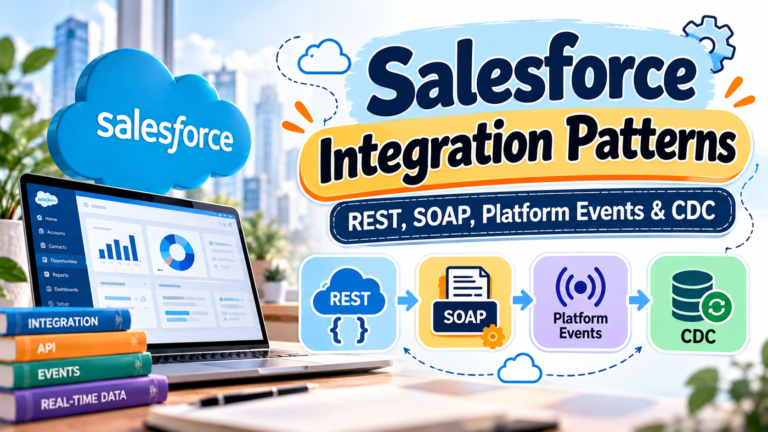
Salesforce provides several integration technologies, but four commonly discussed options are REST API, SOAP API, Platform Events, and Change Data Capture (CDC).
Understanding when to use each approach can help Salesforce developers and architects build integrations that are scalable, reliable, and easier to maintain.
What Are Salesforce Integration Patterns?
A Salesforce integration pattern describes how Salesforce exchanges data or events with another system.
Depending on the business requirement, an integration may need to:
- Request information immediately
- Send or receive records
- Notify another application when something happens
- Process events asynchronously
- Synchronize Salesforce changes with external systems
REST, SOAP, Platform Events, and CDC solve different parts of these integration requirements.
1. Salesforce REST API
The Salesforce REST API enables external applications to interact with Salesforce through HTTP-based requests.
It is widely used for modern web applications, mobile apps, middleware, and lightweight integrations.
How It Works
An external application can send requests to Salesforce to perform operations such as:
GET → Retrieve data
POST → Create data
PATCH → Update data
DELETE → Delete data
For example, an e-commerce application might use an API to create or update customer information in Salesforce.
When Should You Use REST?
REST is a strong choice when:
- Building web or mobile integrations
- Working with JSON-based payloads
- Creating relatively lightweight integrations
- An external system needs on-demand Salesforce data
- You want a commonly used API style for modern applications
Example
Suppose a company has a customer portal.
When a customer updates their contact information, the portal can send an API request to Salesforce to update the corresponding Contact record.
Best suited for: Modern, request-response API integrations.
2. Salesforce SOAP API
The SOAP API provides a standards-based web service interface for communicating with Salesforce.
SOAP commonly uses XML messages and a WSDL (Web Services Description Language) contract.
Compared with REST, SOAP can be useful when an enterprise integration requires a strongly defined service contract.
When Should You Use SOAP?
SOAP may be appropriate when:
- The external application is built around SOAP web services
- A WSDL-based contract is required
- You are integrating with legacy enterprise applications
- XML-based communication is part of the existing architecture
Example
Imagine an older enterprise ERP platform that already communicates with other applications through SOAP services.
Instead of redesigning the entire integration architecture, the organization may integrate that platform with Salesforce through SOAP API.
Best suited for: Contract-driven and legacy enterprise integrations.
REST vs SOAP
| Feature |
REST |
SOAP |
| Common payload format |
JSON |
XML |
| Style |
Resource-oriented API |
Web-service protocol |
| Contract |
Generally more flexible |
WSDL-based |
| Typical use |
Modern apps and services |
Enterprise/legacy integrations |
| Complexity |
Usually simpler |
Generally more structured |
| Communication model |
Request-response |
Request-response |
The important point is that REST is not automatically better than SOAP. The correct choice depends on the architecture and requirements of the systems being integrated.
3. Salesforce Platform Events
Not every integration should wait for an immediate response.
Sometimes Salesforce simply needs to announce:
“Something happened.”
That is where Platform Events become useful.
Platform Events support event-driven architectures, allowing publishers and subscribers to communicate asynchronously.
Instead of tightly coupling two applications together, one application publishes an event and interested subscribers can react to it.
Example
Imagine an insurance application.
When a claim reaches a particular stage,