
Salesforce Skills That Employers Look For: A Complete Guide to Becoming Job-Ready
## Introduction
Salesforce has become an important technology for organizations that want to manage customer relationships, automate business processes, analyze data, and improve customer experiences. As companies continue to use CRM and cloud technologies, professionals with practical Salesforce skills can explore a variety of career opportunities.
However, learning Salesforce is not simply about completing a syllabus. Employers want candidates who can understand business requirements, configure solutions, solve problems, work with data, and communicate their ideas clearly.
This is why many beginners ask an important question:
**”What Salesforce skills should I learn to become job-ready?”**
The answer depends on the role you want to pursue. An Administrator needs a different skill set from a Developer, while a Consultant or Integration Specialist may require additional business and technical knowledge.
In this guide, we’ll explore the most important Salesforce skills that can help you build a strong foundation and prepare for professional opportunities.
—
# 1. Salesforce CRM Fundamentals
Before learning advanced features, you should understand the basics of CRM.
Learn how businesses use Salesforce to:
* Manage leads
* Track opportunities
* Store customer information
* Manage customer service
* Automate processes
* Generate reports
Understanding the business purpose behind Salesforce features makes technical learning much easier.
—
# 2. Salesforce Administration
Administration is one of the most important foundations for Salesforce professionals.
Important topics include:
* Users
* Profiles
* Permission Sets
* Roles
* Objects
* Fields
* Page Layouts
* Record Types
* Reports
* Dashboards
A strong Administration foundation helps you understand how Salesforce organizations are configured and managed.
—
# 3. Data Management
Salesforce applications depend on accurate and organized data.
Professionals should understand:
* Data Import Wizard
* Data Loader
* Data Export
* Duplicate Management
* Validation Rules
* Data Quality
* Object Relationships
Practice importing, updating, and maintaining records in a Salesforce environment.
—
# 4. Salesforce Security
Security is an essential part of Salesforce Administration.
You should understand:
* Organization-Wide Defaults
* Profiles
* Permission Sets
* Role Hierarchy
* Sharing Rules
* Field-Level Security
Interviewers often use real business scenarios to test whether candidates understand how access should be controlled.
—
# 5. Flow Builder and Automation
Automation is one of the most valuable Salesforce skills.
Learn how to create:
* Record-Triggered Flows
* Screen Flows
* Scheduled Flows
* Auto-Launched Flows
For example, you might create a Flow that automatically updates a customer’s status when a business condition changes.
Practical automation experience can make your profile much stronger.
—
# 6. Reports and Dashboards
Businesses rely on Salesforce reports and dashboards to understand their operations.
Learn how to create:
* Tabular Reports
* Summary Reports
* Matrix Reports
* Joined Reports
* Dashboards
* Charts
Don’t just learn how to create a report. Understand what business question the report is designed to answer.
—
# 7. Apex Programming
If you’re interested in Salesforce Development, Apex is an important skill.
Learn:
* Apex Classes
* Methods
* Variables
* Collections
* Triggers
* Exception Handling
* Test Classes
Apex allows developers to implement custom business logic that cannot always be handled through configuration.
—
# 8. SOQL
Salesforce developers need to understand how to retrieve data efficiently.
SOQL stands for **Salesforce Object Query Language**.
Learn how to:
* Query records
* Filter data
* Sort results
* Work with relationships
* Retrieve specific fields
Practice writing queries using realistic business scenarios.
—
# 9. Lightning Web Components
Lightning Web Components, commonly called LWC, are an important part of modern Salesforce development.
Developers should understand:
* HTML
* JavaScript
* Component Structure
* Data Binding
* Events
* Properties
* Apex Integration
Building small components regularly is one of the best ways to improve LWC skills.
—
# 10. Salesforce Integration
Businesses often need Salesforce to communicate with external applications.
Important concepts include:
* REST APIs
* SOAP APIs
* JSON
* OAuth
* Authentication
* API Testing
Understanding integration helps professionals work on more complex enterprise solutions.
—
# 11. Problem-Solving Skills
Technical knowledge becomes valuable when you can use it to solve business problems.
Employers want professionals who can:
* Understand requirements
* Identify problems
* Analyze possible solutions
* Select the right Salesforce feature
* Test solutions
* Troubleshoot errors
Instead of asking, “Which feature should I memorize?”, ask:
**”What business problem am I trying to solve?”**
This approach improves your Salesforce thinking.
—
# 12. Business Understanding
Salesforce professionals work closely with business teams.
You should understand concepts such as:
* Sales Processes
* Lead Management
* Customer Service
* Case Management
* Approval Processes
* Business Automation
Business knowledge helps you design solutions that are useful rather than simply technically correct.
—
# 13. Communication Skills
Communication is often overlooked by beginners.
A Salesforce professional may need to explain technical concepts to:
* Managers
* Clients
* Business Analysts
* Developers
* Administrators
* End Users
You should be able to explain your solution in simple and professional language.
—
# 14. Practical Project Experience
Employers want to know whether you can apply your knowledge.
Build projects such as:
### Sales Management System
Manage leads, accounts, contacts, and opportunities.
### Customer Support System
Manage cases, priorities, service requests, and customer information.
### Employee Management System
Manage employee records, departments, leave requests, and approvals.
Projects give you practical examples to discuss during interviews.
—
# 15. Certification Knowledge
Salesforce certifications can strengthen your professional profile.
Beginners can explore the Salesforce Administrator certification, while developers and experienced professionals can consider certifications aligned with their career goals.
However, certification should complement practical knowledge.
A certificate alone does not replace hands-on experience.
—
# How to Become Job-Ready in Salesforce
A structured roadmap can make learning easier.
### Stage 1: Foundation
Learn CRM and Salesforce basics.
### Stage 2: Administration
Study objects, security, data, reports, and automation.
### Stage 3: Practical Projects
Build realistic business applications.
### Stage 4: Development
If interested in coding, learn Apex, SOQL, and LWC.
### Stage 5: Integration
Understand APIs and external system communication.
### Stage 6: Certification
Prepare for a relevant Salesforce certification.
### Stage 7: Career Preparation
Build your resume, practice interviews, and improve communication.
—
# Common Mistakes Salesforce Beginners Make
Avoid these mistakes:
* Learning only theory
* Ignoring Flow Builder
* Skipping practical projects
* Trying to learn everything at once
* Memorizing interview answers
* Adding skills to a resume without practicing them
* Ignoring communication skills
A focused learning strategy produces better results.
—
# Why Choose Prabh Kirpa Classes?
Prabh Kirpa Classes provides practical Salesforce training designed to help learners build technical knowledge and career readiness.
Training areas include:
* Salesforce Administration
* Salesforce Development
* Lightning Web Components
* Salesforce Integration
* OmniStudio
* Practical Assignments
* Live Projects
* Certification Guidance
* Resume Building
* Mock Interviews
* Job Support
The focus is on combining structured learning with hands-on practice and career preparation.
—
# Frequently Asked Questions
### What Salesforce skill should beginners learn first?
Salesforce fundamentals and Administration are a strong starting point for most beginners.
### Is coding necessary for a Salesforce career?
Not for every Salesforce role. Administration can be learned without extensive programming, while Developer roles require coding skills.
### Are Salesforce projects important for jobs?
Yes. Projects help demonstrate that you can apply your knowledge to practical business scenarios.
### Does certification guarantee a Salesforce job?
No. Certification can strengthen your profile, but practical skills, projects, communication, and interview performance also matter.
—
# Conclusion
Building a Salesforce career requires more than learning individual features. Employers value professionals who understand CRM concepts, can configure or develop Salesforce solutions, solve business problems, work with data, and communicate effectively.
Start with a strong foundation and gradually develop advanced skills according to your chosen career path. Combine learning with practical projects, certification preparation, interview practice, and continuous improvement.
At **Prabh Kirpa Classes**, learners receive structured Salesforce training along with practical assignments, live projects, certification guidance, resume preparation, mock interviews, and job support. With consistent practice and the right learning roadmap, you can develop the skills needed to move confidently toward a Salesforce career.
Newsletter
Recent Posts
Salesforce Placement Support for Freshers: From Training to Interview Preparation
Introduction Starting a career after graduation can be challenging. Many

Salesforce Job Support: How Training, Guidance and Career Assistance Can Help You Become Job-Ready
Introduction Learning Salesforce can open the door to exciting opportunities
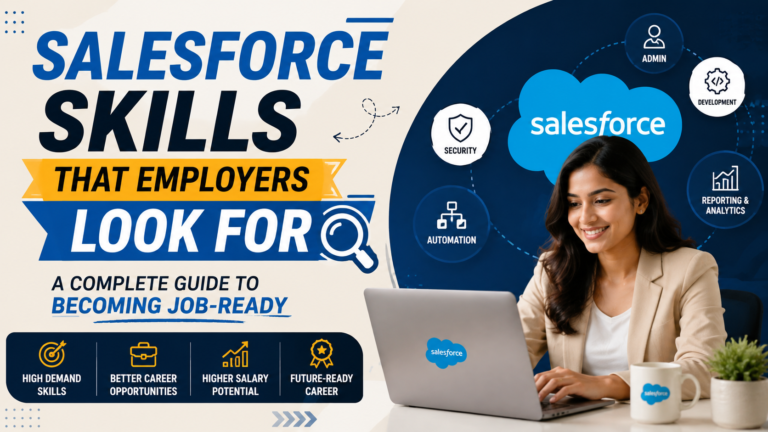
Salesforce Skills That Employers Look For: A Complete Guide to Becoming Job-Ready
## Introduction Salesforce has become an important technology for organizations

Which Act Is Being Amended by the Foreign Contribution (Regulation) Amendment Bill, 2026?
How well do you follow the latest developments in Indian